
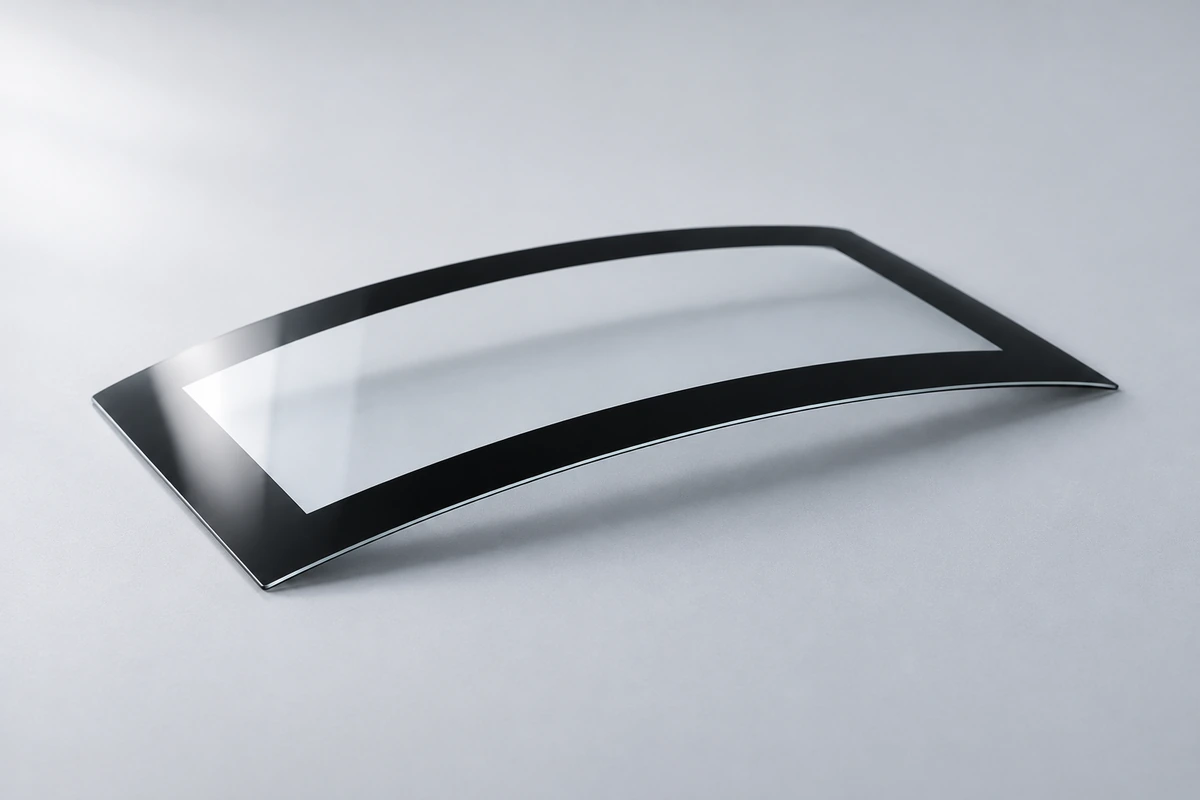
That's different from the "2.5D" glass on most phones, which is still a flat sheet with its top edges ground into a gentle roll-off. The difference sounds small, but it changes how the glass is made, what it costs and what it's good for.
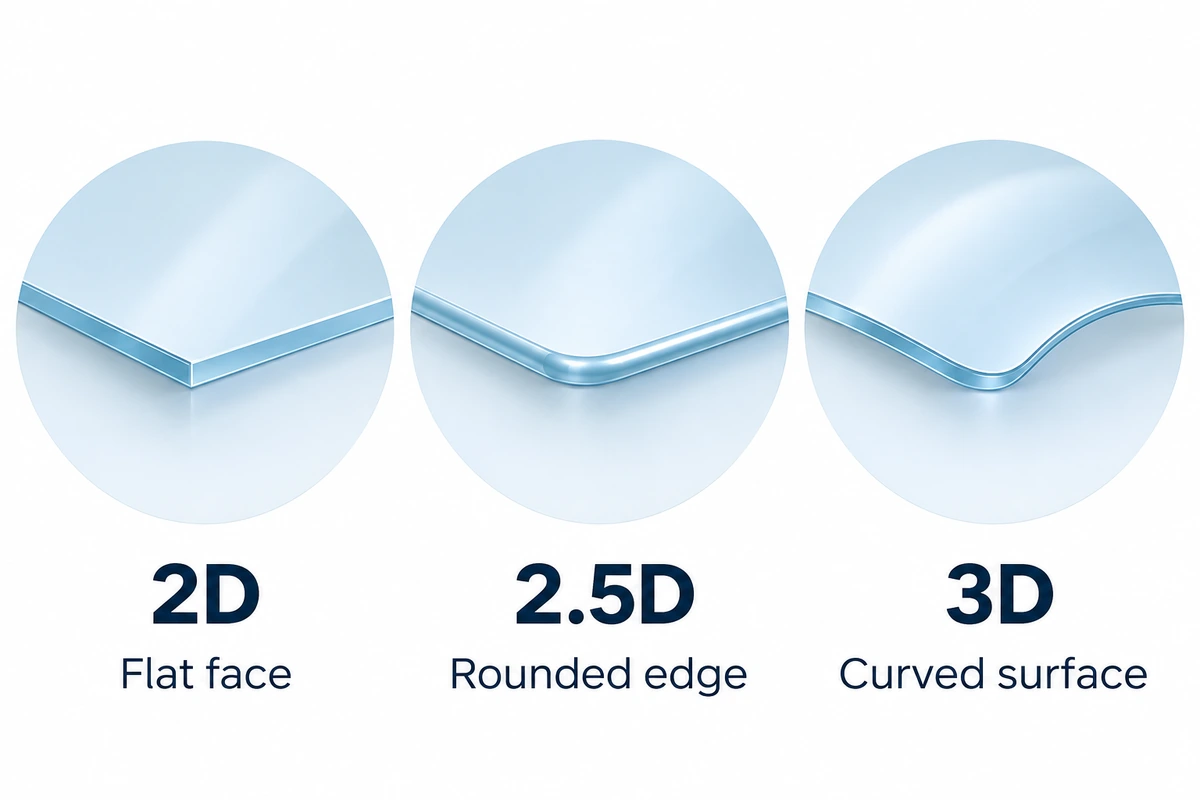
2D, 2.5D and 3D in Plain Terms
2D glass is completely flat, with straight-cut edges. It's the simplest and cheapest option. Many industrial panels, appliance screens and basic devices use it.
2.5D glass is still flat, but its top edges are ground and polished into a smooth curve. When you slide your thumb off the edge of most phones, that soft roll-off is 2.5D. The curve is made by grinding, so the sheet itself never bends.
3D glass is bent as a whole. The edges, and sometimes the entire surface, curve away from flat. On a curved-edge phone, the display itself wraps around the sides, and the glass has to follow it. You can't grind that shape out of a flat sheet; the glass has to be formed.
A quick way to tell them apart: lay the glass on a table. 2D and 2.5D lie flat. 3D rocks or stands up on its curved edges.
How 3D Cover Glass Is Made
The process starts like any other cover glass and then adds a forming stage in the middle.
First, a flat blank is cut, CNC-machined to shape, and polished. Then comes hot bending: the glass is heated until it softens, roughly in the 500–700 °C (930–1,290 °F) range depending on the glass, and pressed into a precision mold. The molds are usually made of graphite, because it handles heat well and can be machined very accurately. The glass is then cooled slowly so it doesn't build up internal stress or warp.
After bending, the glass needs work again:
- Polishing, because the mold's surface texture transfers to the glass, and any marks have to be polished out of the curved faces.
- Chemical strengthening in a hot salt bath, done after bending. Heating already-strengthened glass would undo the strengthening.
- Printing and coatings, such as a black border, anti-fingerprint or anti-reflective layers, applied last.
One phone maker that showed its 3D glass line described the full process as more than 14 steps.
Why 3D Costs More
3D cover glass is usually several times the price of a 2.5D part. The reasons stack up.
Every shape needs its own mold. A new curve means a new set of precision graphite molds, and molds wear out with use, so they're replaced regularly.
There's more processing. Forming adds heating, pressing and slow cooling. Polishing a curved surface is harder than polishing a flat one. Printing a border onto a curved surface is also more involved than printing on flat glass.
Yield is lower. Small mismatches between how the glass and the mold expand with heat, glass sticking to the mold, or trapped debris can all push parts out of shape. Manufacturers describe 3D glass as having noticeably lower yields than flat glass, especially on larger parts.
So 3D makes sense when the curve is genuinely part of the product: a wraparound display, a watch face that flows into its case, or a premium handheld where the feel is a selling point. If the goal is simply a smooth edge under the thumb, 2.5D gets most of the effect at a fraction of the cost.
The Other Way to Curve Glass: Cold Forming
Car interiors increasingly use large curved displays that sweep across the dashboard. Hot-forming glass that big is expensive and hard to keep optically perfect. So the industry also uses cold forming.
With cold forming, the glass is cut, strengthened, printed and coated while flat, then bent to shape at room temperature and held in place by the display's frame or bonding. Corning, which offers this as ColdForm technology, says it can produce C-shaped curves for dashboards and S-shaped curves for center consoles, and that it costs less than hot forming because the glass is processed and shipped flat.
Cold forming suits gentle, sweeping curves on large, thin glass. Tight curves, like the wraparound edges of a phone, still need hot forming.
Before You Commit to 3D
If you're considering 3D cover glass for a product, these questions shape the cost and the lead time more than anything else:
How tight is the curve? Gentle curves are easier to form and polish than tight wraparound edges. The tighter the bend, the harder it gets.
How many will you make? Mold costs are spread across the production run. At low volumes, 3D can be hard to justify. 2.5D, or flat glass inside a curved housing, may get you close.
Does it need to be large? Bigger 3D parts are harder to form without distortion. For large, gently curved displays, cold forming may be the better route.
What goes on the glass after bending? Printed borders, logos, anti-fingerprint and anti-reflective coatings all need to work on a curved surface. Check what's achievable on your shape before locking the design.
How will the curve be checked? Curved parts are measured against a 3D model, often with scanning equipment, so the supplier needs a clear 3D file and an agreed tolerance on the curve.
If you're weighing 2.5D against 3D for a product, send us a sketch or a 3D model, and we'll tell you what's realistic for the shape.