
Panda Cover Glass Material Guide
We fabricate Panda Glass, the high-alumina silicate cover glass developed by Tunghsu Group, into custom cover glass from 0.3 mm to 8.0 mm thick. Working with the Panda-1681 and Panda-MN228 grades, we CNC shape, chemically strengthen, coat and print parts for industrial, smart home, medical and automotive displays.
Capabilities

Glass grades
Panda-1681 · Panda-MN228

Thickness
0.3–8.0 mm (0.012–0.31 in)

Edge profiles
2.5D, C-edge, beveled · Drilled holes, slots, cutouts

Surface treatments
AR, AG coating · AF / AS coating

Silkscreen printing
Up to 10 print layers · Multi-color

Inspection
100% visual inspection · Dimensional sampling to AQL 0.25
Gallery
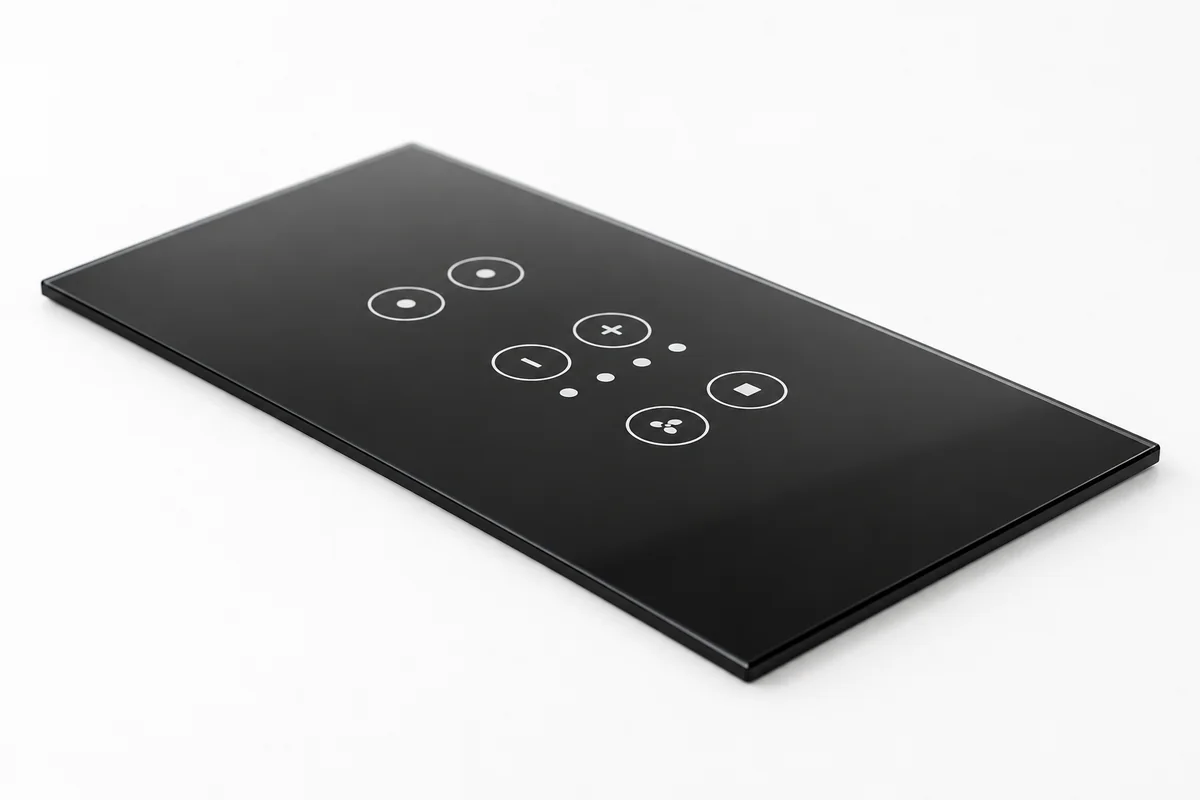
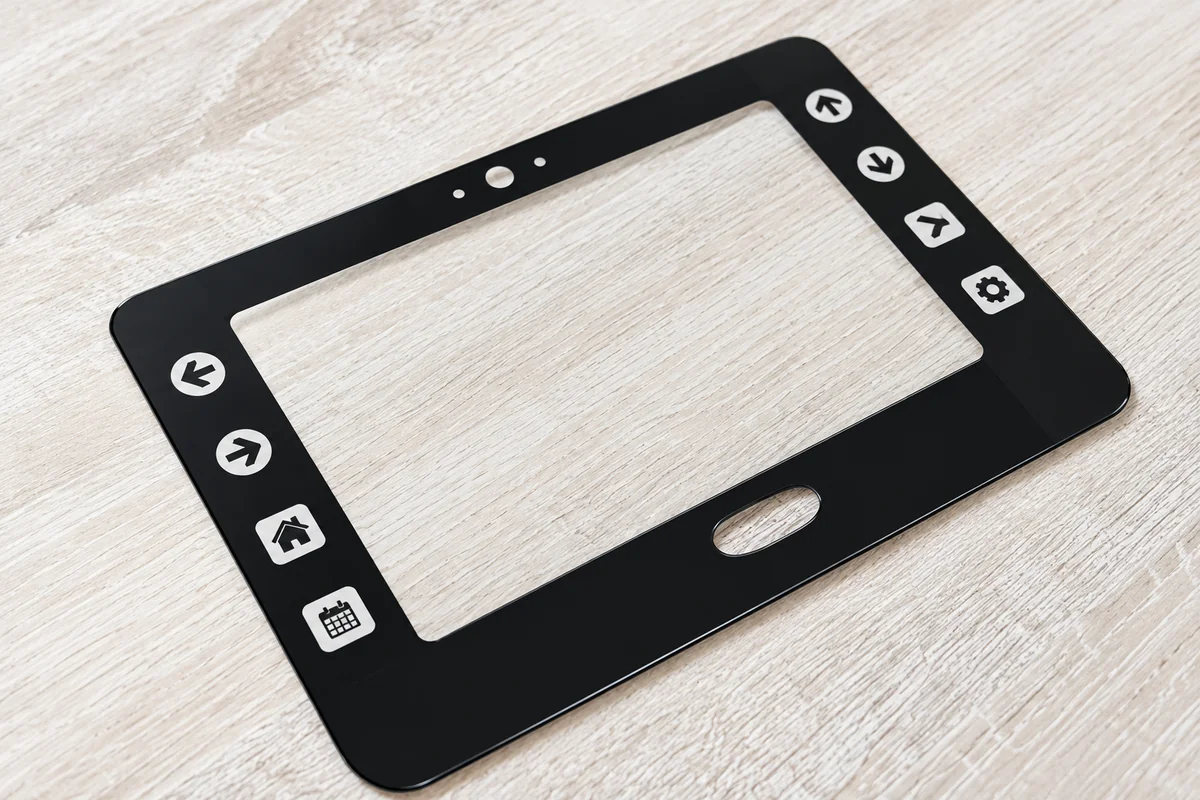


Get a Panda cover glass quote
Send your drawing with thickness, edge, printing and coating needs, and we will confirm the Panda grade and process route.
Panda-1681 vs. Panda-MN228
Panda Glass is a chemically strengthenable, high-alumina silicate cover glass, and it comes in two main grades: Panda-1681 for higher strength after ion exchange, and Panda-MN228 as the general-purpose grade.
| Parameter | Panda-MN228 | Panda-1681 |
|---|---|---|
| Density | 2.46 g/cm³ | 2.41 g/cm³ |
| Visible transmittance (D65, 0.55 mm) | ≥91.5% | ≥92% |
| Thermal expansion (0–300 °C) | 7.8–8.5 × 10⁻⁶ /K | 7.5–8.0 × 10⁻⁶ /K |
| Softening point | 780–810 °C | 830–850 °C |
| Young’s modulus | 65–70 GPa | 70–75 GPa |
| Vickers hardness (200 gf, 20 s) | 580–640 HV | 600–670 HV |
| Bending strength, unstrengthened (4-point) | 180–220 MPa | 200–250 MPa |
| Surface compressive stress (CS) | ≥750 MPa | ≥900 MPa |
| Depth of layer (DOL) | ≥35 µm | ≥45 µm |
| Ball drop (0.55 mm, strengthened, 60 g ball, sandpaper surface) | ≥120 cm | ≥180 cm |
Panda-1681 also bends to a 100 mm radius at 0.55 mm thickness.
Choosing Between the Two Grades
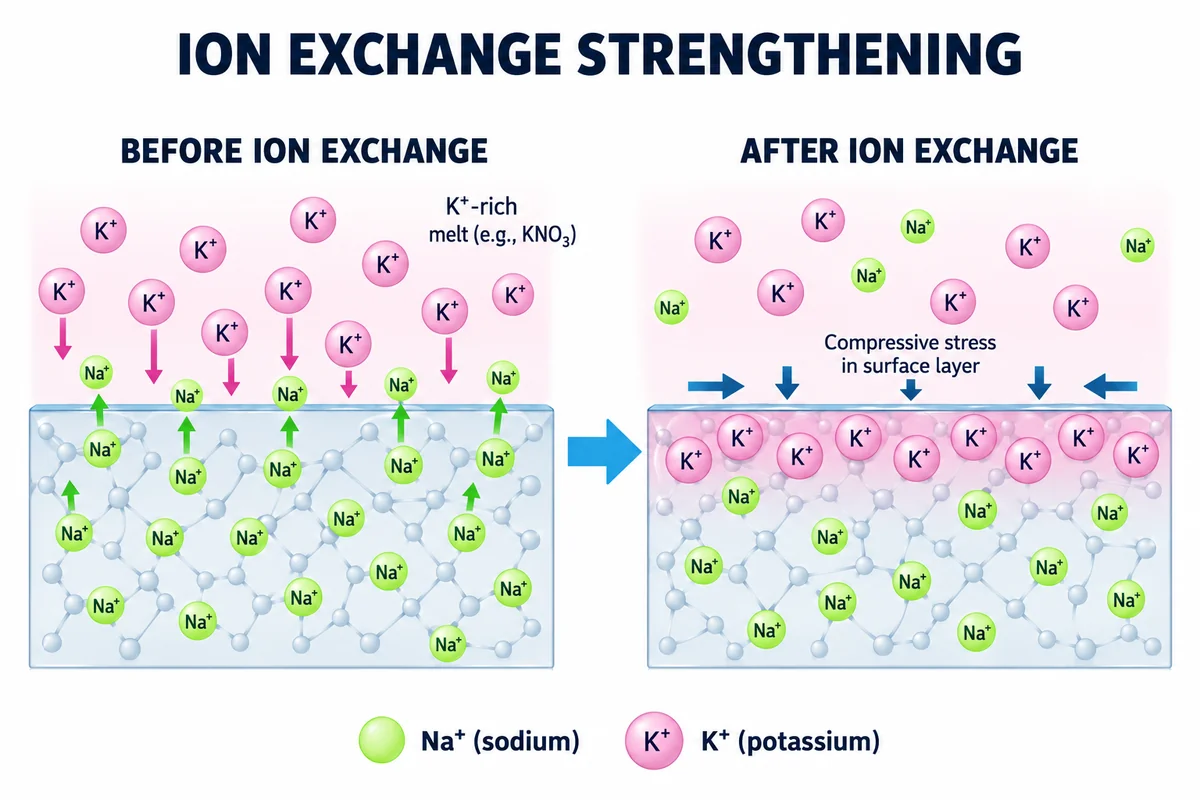
The strengthening numbers decide most grade choices. Compressive stress (CS) is how hard the strengthened surface is squeezed, and depth of layer (DOL) is how deep that squeezed layer reaches. A scratch or chip only becomes dangerous when it cuts through the layer into the glass beneath, so a deeper layer gives more margin against surface damage in use. Panda-1681 is ahead on both, with at least 900 MPa and 45 µm against 750 MPa and 35 µm, and it reaches at least 180 cm in the 0.55 mm ball drop test compared with 120 cm for MN228.
In practice, we specify Panda-1681 for thin covers, handheld and wearable devices, and touch surfaces that take knocks or sit outdoors. Panda-MN228 suits framed panels, smart home controls and industrial displays where the cover is supported on all sides and impact risk is lower. As with any chemically strengthened glass, cutting, drilling and edging are finished before ion exchange so the compressed layer covers every edge.
Where Panda Cover Glass Is Used
- Industrial equipment: HMIs, control panels, automation displays, portable and ruggedized devices, and test and measurement instruments.
- Smart home: thermostats, lock panels and wall control panels with printed icons and AF-coated touch surfaces.
- Automotive and EV charging: in-vehicle infotainment displays and EV charging station screens.
- Medical and healthcare: device displays and touch panels that are cleaned often.
- Commercial displays: interactive kiosks and digital signage, usually with AG or AR coatings.
- Consumer and wearable devices: smartphones, tablets, e-readers, laptops, cameras and smart wearables.
Panda Glass FAQ
How does Panda Glass compare with Gorilla Glass and Dragontrail?
All three are chemically strengthened aluminosilicate cover glasses with comparable strength and optical quality for most devices. Panda Glass is generally the lower-cost option, while Gorilla Glass carries the strongest brand recognition. We fabricate all three and can quote the same drawing in more than one material.
Can Panda Glass be used outdoors?
Yes. With an AG coating for readability in bright light, or an AR coating for higher transmission, it suits interactive kiosks, industrial HMIs and outdoor instruments.
Is there a minimum order quantity?
No. We accept orders of any quantity, from samples to volume production.