
NIR & Dual Bandpass Filters
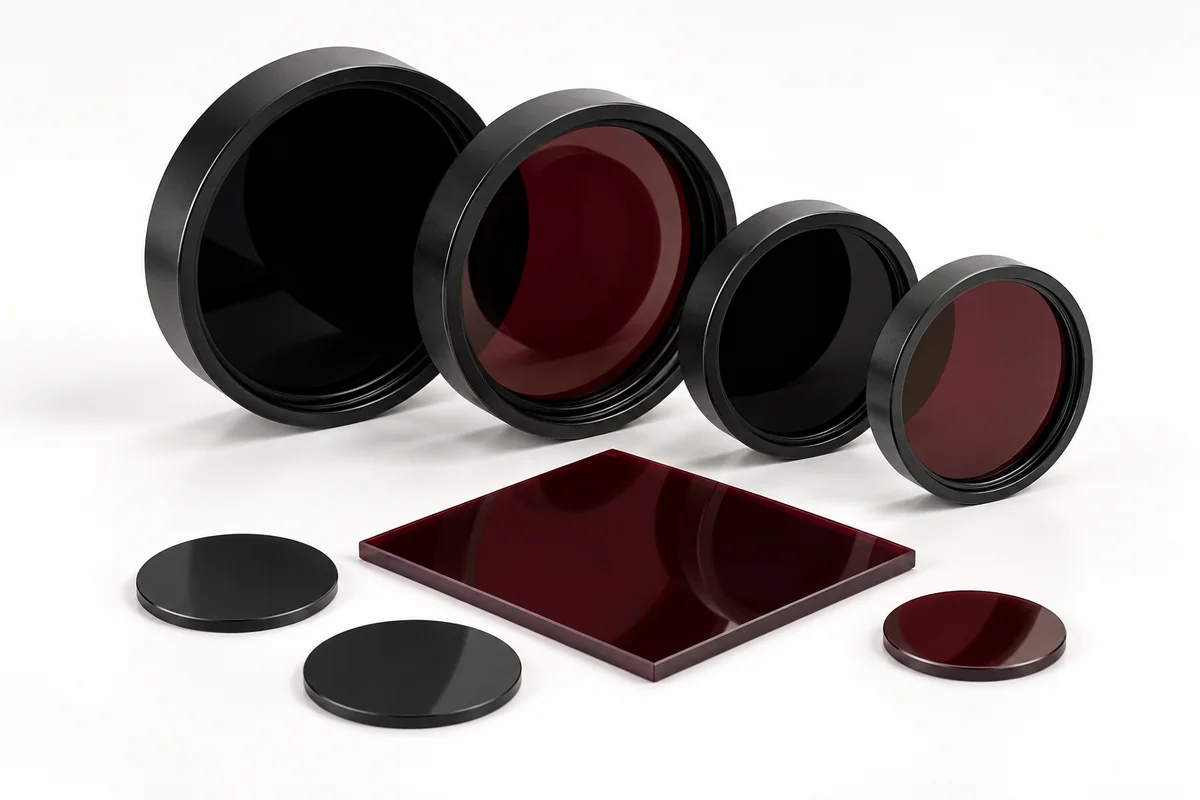
NIR bandpass filters pass one near-infrared band and block the rest; dual bandpass filters pass two separated bands, usually visible light plus an NIR band. We supply standard bands from 680 nm to 1645 nm in broadband, narrow and interference widths, and dual filters for day-night cameras and NDVI imaging, all hard-coated on a single substrate.
Capabilities

NIR bands
680–1100 nm · 735, 808, 850, 905, 940 nm lines

SWIR bands
1300, 1450, 1550 nm · For InGaAs sensors

Bandwidth
15–25 nm interference, ±5 nm · 40–100 nm broadband, ±10 nm

Dual bandpass
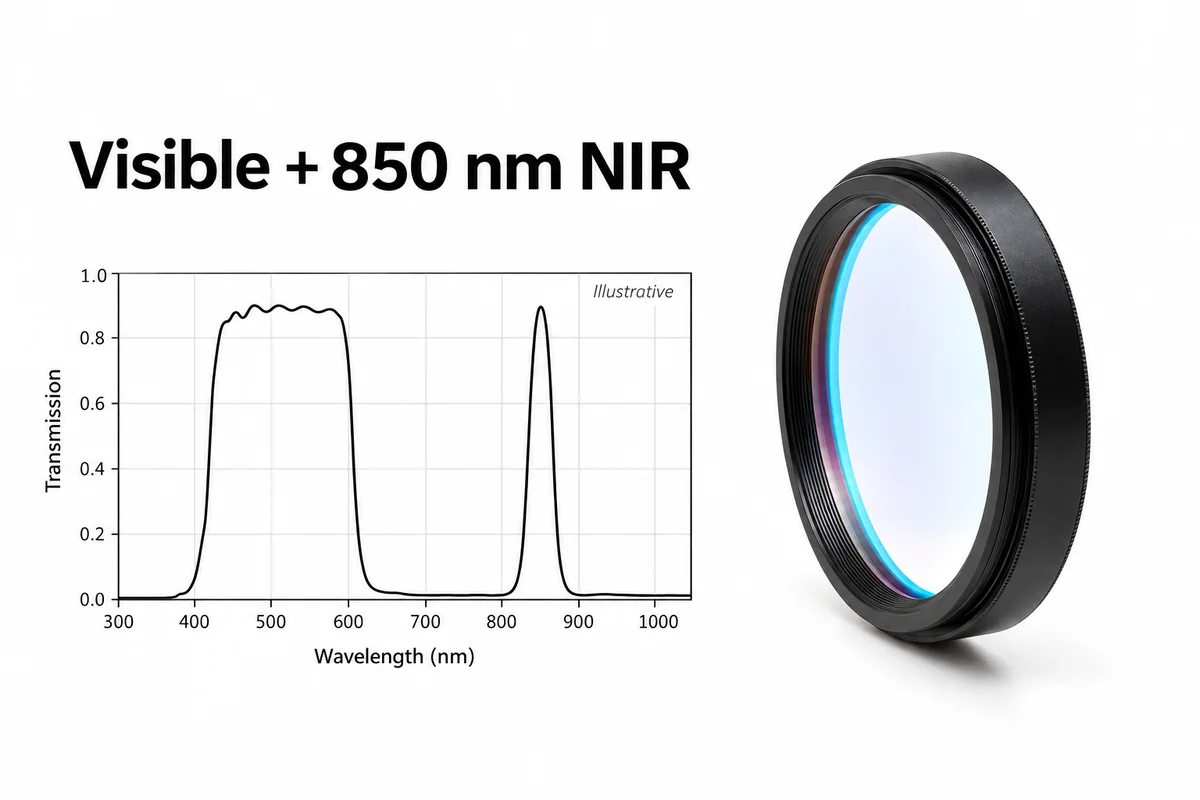
Visible + 735, 850 or 940 nm · Blue, green or red + 850 nm
Peak transmission
≥85–90% on most bands · AR coated

Construction
Hard-coated, single substrate · 40/20 scratch-dig
Gallery
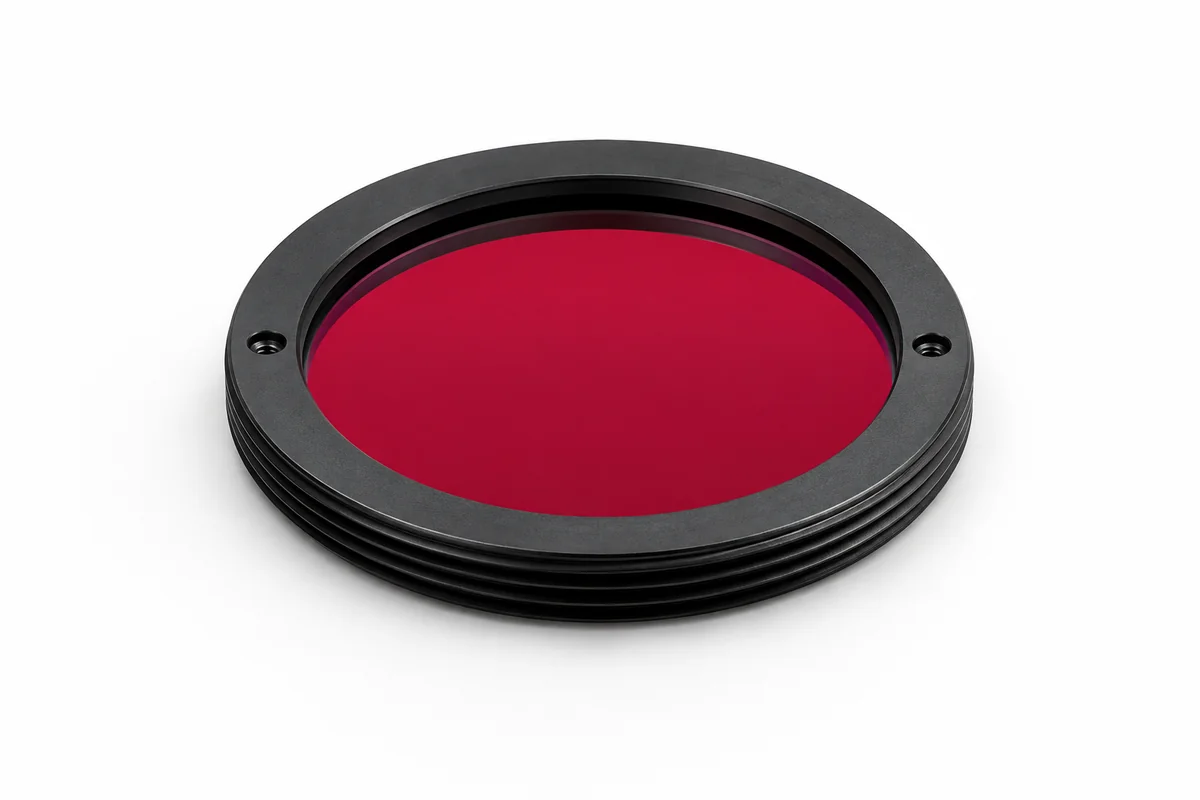
Get an NIR bandpass filter quote
Tell us the LED or laser wavelength, the sensor, whether you also need visible light, and the size, and we will match a band and width or quote a custom filter.
Wavelength First, Then Bandwidth
Start with the illumination wavelength, then decide how tightly to filter around it. At 850 nm, silicon sensors are more sensitive and the LED shows a faint red glow. At 940 nm the LED is invisible to the eye, and sunlight is weaker because water vapor absorbs part of the solar spectrum there, so outdoor cameras see less ambient light, at the cost of lower sensor response.
Most of our NIR bands come in three widths. Broadband BP filters pass 40–100 nm at ±10 nm, narrow BN filters pass 22–35 nm at ±7 nm, and Bi interference filters pass 15–25 nm at ±5 nm. At 850 nm that means 820–910 nm, 840–865 nm or 845–860 nm.
A narrower band rejects more sunlight and stray light, but it still has to cover the source. LED output spreads over roughly 30–50 nm and drifts with temperature, so LED-lit systems use broadband or narrow filters. Interference filters are for laser lines, which are only a few nanometers wide.
Standard NIR and SWIR Bands
Pass ranges by band and width. Peak transmission is 90% or higher on most broadband filters and 85–90% on narrow and interference filters.
| Band | Broadband (BP, ±10 nm) | Narrow (BN, ±7 nm) | Interference (Bi, ±5 nm) |
|---|---|---|---|
| 700 nm | BP695: 680–720 nm · BP735: 715–780 nm | BN740: 730–755 nm | Bi750: 710–765 nm |
| 780–810 nm | BP800: 770–790 nm | BN810: 798–820 nm | Bi808: 798–820 nm |
| 830 nm | — | — | Bi830: 810–850 nm · Bi832: 822–846 nm |
| 850 nm | BP850: 820–910 nm | BN850: 840–865 nm | Bi850: 845–860 nm |
| 880 nm | BP880: 845–930 nm | BN880: 855–890 nm | — |
| 905 nm | — | — | Bi905: 895–915 nm |
| 940 nm | — | BN940: 928–955 nm | Bi940: 930–952 nm |
| 1000 nm | BP1000: 930–1030 nm (≥80%) | — | — |
| 1300–1550 nm | BP1550: 1485–1645 nm | — | Bi1300: 1290–1310 nm · Bi1450: 1440–1460 nm · Bi1550: 1540–1560 nm (±10 nm) |
Other center wavelengths and tighter bandwidths are made to order.
Dual Bandpass Filters
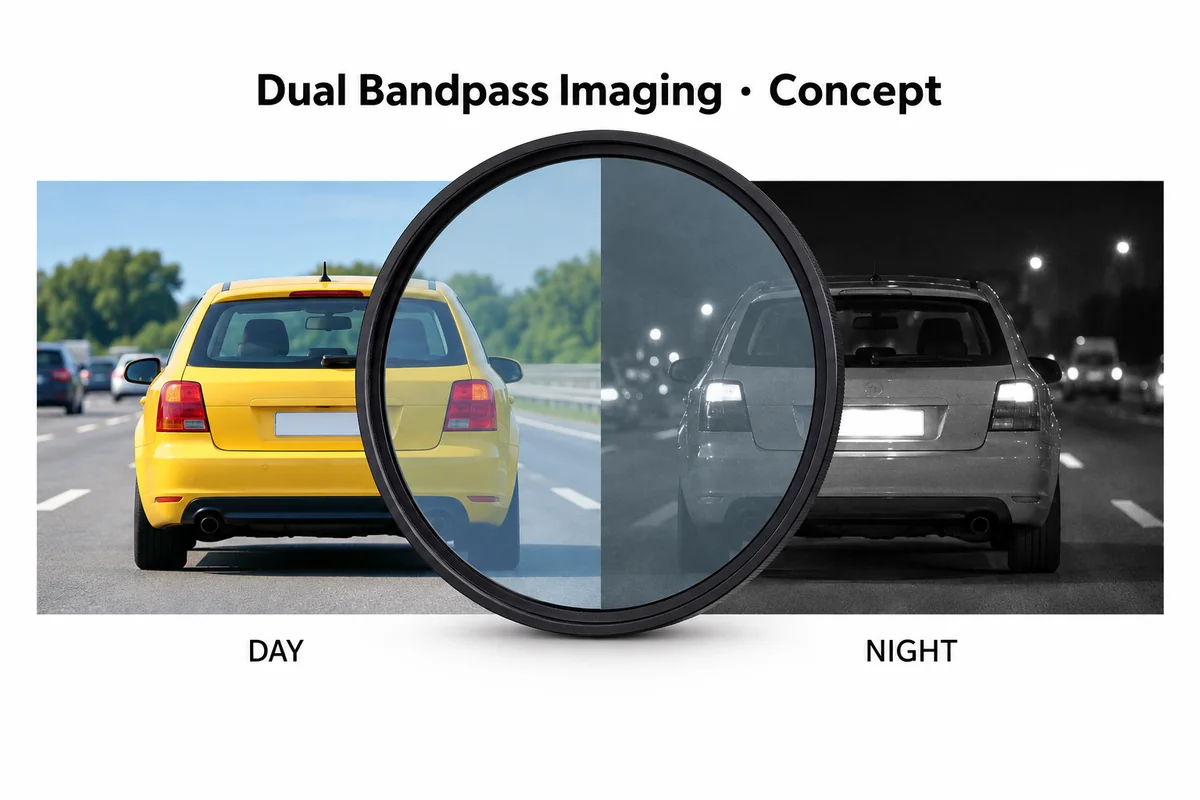
Visible + NIR for day-night cameras
The DB735, DB850 and DB940 pass visible light from 405 nm to 645–650 nm plus one NIR band at 725–755 nm, 835–875 nm or 925–965 nm. One fixed filter covers color imaging by day and IR-lit imaging at night, with no mechanical IR-cut switch. Match the NIR band to the camera’s illuminator; the DB850 and DB940 hold the NIR band to ±10 nm.
One color band + 850 nm
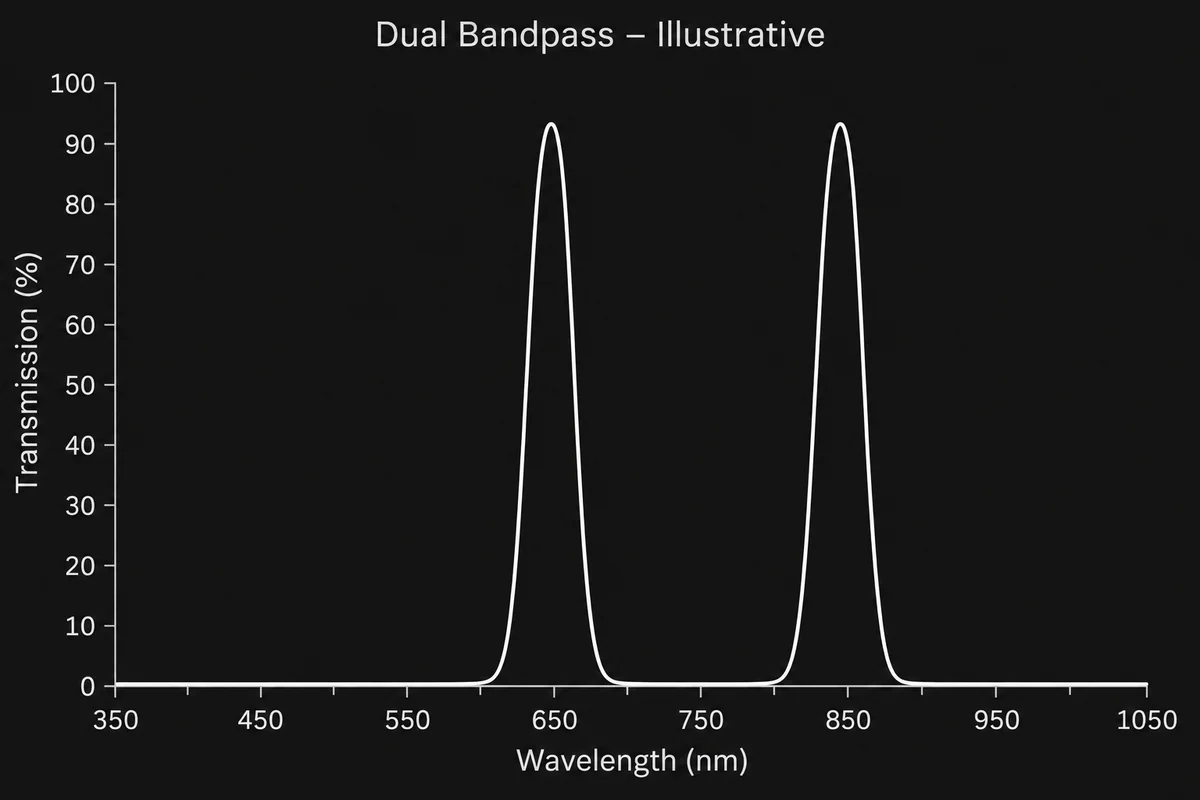
The DB475/850, DB550/850 and DB660/850 pass a 30 nm blue, green or red band plus 830–870 nm, at ±5 nm. The DB660/850 pairs red with near-IR, the combination used for NDVI crop-health imaging from drones.
Absorptive visible + NIR
The DB395/870 passes 375–425 nm and 745–970 nm using absorbing filter glass, so its bands do not shift with the angle of incidence. It suits wide-angle lenses where a coated dual filter would drift.
Matching Laser and Sensor Lines
Interference filters isolate a single laser or detection line; pick the one centered on your source.
808 nm laser diodes
The Bi808 passes 798–820 nm at ±5 nm, for pump and illumination lasers; the BN810 covers the same range at ±7 nm.
905 nm LiDAR
The Bi905 passes 895–915 nm, isolating the return pulse of 905 nm laser rangefinders and LiDAR from sunlight.
NIR fluorescence
The Bi830 and Bi832 isolate 810–850 nm, the emission region of NIR dyes such as indocyanine green in biomedical imaging.
1300 and 1550 nm on InGaAs
Silicon sensors stop responding near 1100 nm, so these bands pair with InGaAs detectors. The Bi1300 and Bi1550 pass 20 nm windows; the BP1550 passes 1485–1645 nm for broader collection.
1450 nm moisture sensing
The Bi1450 passes 1440–1460 nm, a strong water absorption band used to measure moisture in industrial chemical analysis.