
Visible Bandpass Filters
Visible bandpass filters pass one color band between about 400 and 700 nm and block the rest of the spectrum. We supply standard bands from indigo at 425 nm to dark red at 692 nm in three widths, from 10 nm interference filters held to ±5 nm to broadband filters up to 70 nm wide, with custom centers and bandwidths below 5 nm on request.
Capabilities
Standard bands
425–692 nm · Indigo to dark red
Bandwidth
10–23 nm interference, ±5 nm · 30–70 nm broadband, ±10 nm
Custom
FWHM below 5 nm · Any visible center wavelength
Peak transmission
≥85–90% · AR coated

Construction
Hard-coated thin film · Double-side polished

Shapes and mounts
Round, rectangular, custom · Threaded, C-mount, slip
Gallery
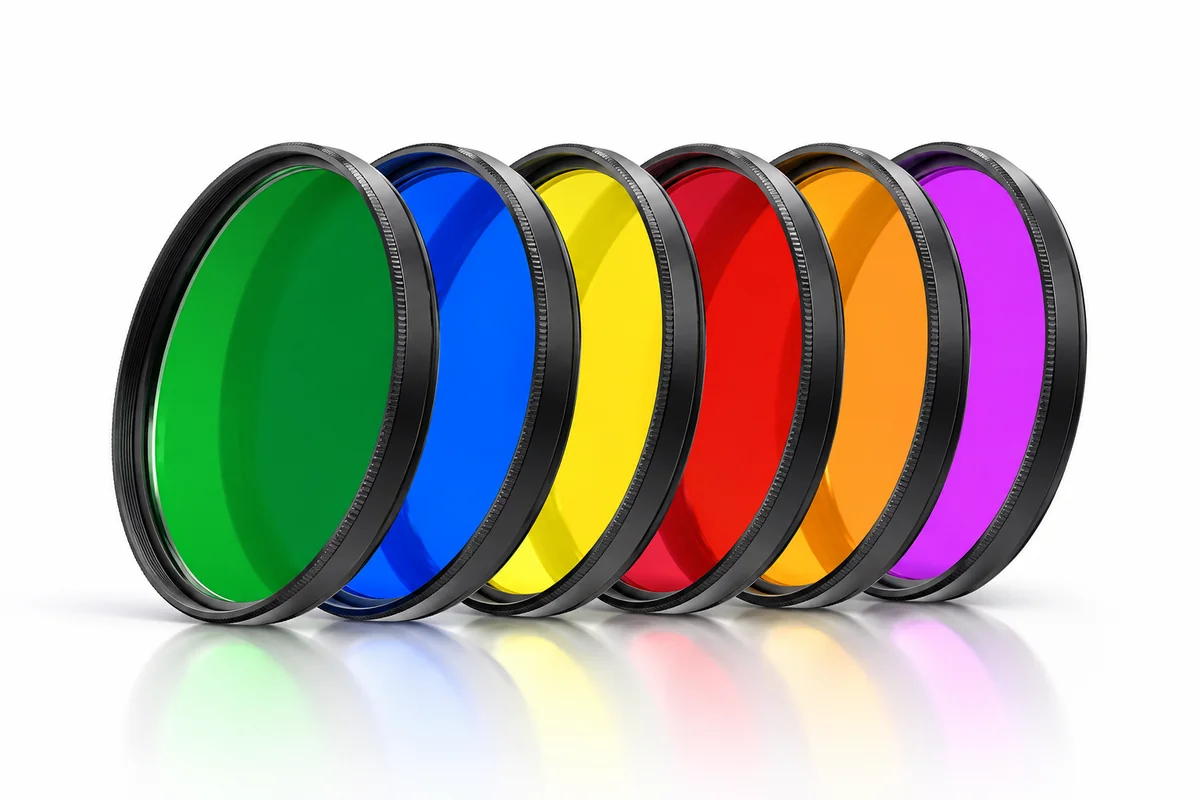
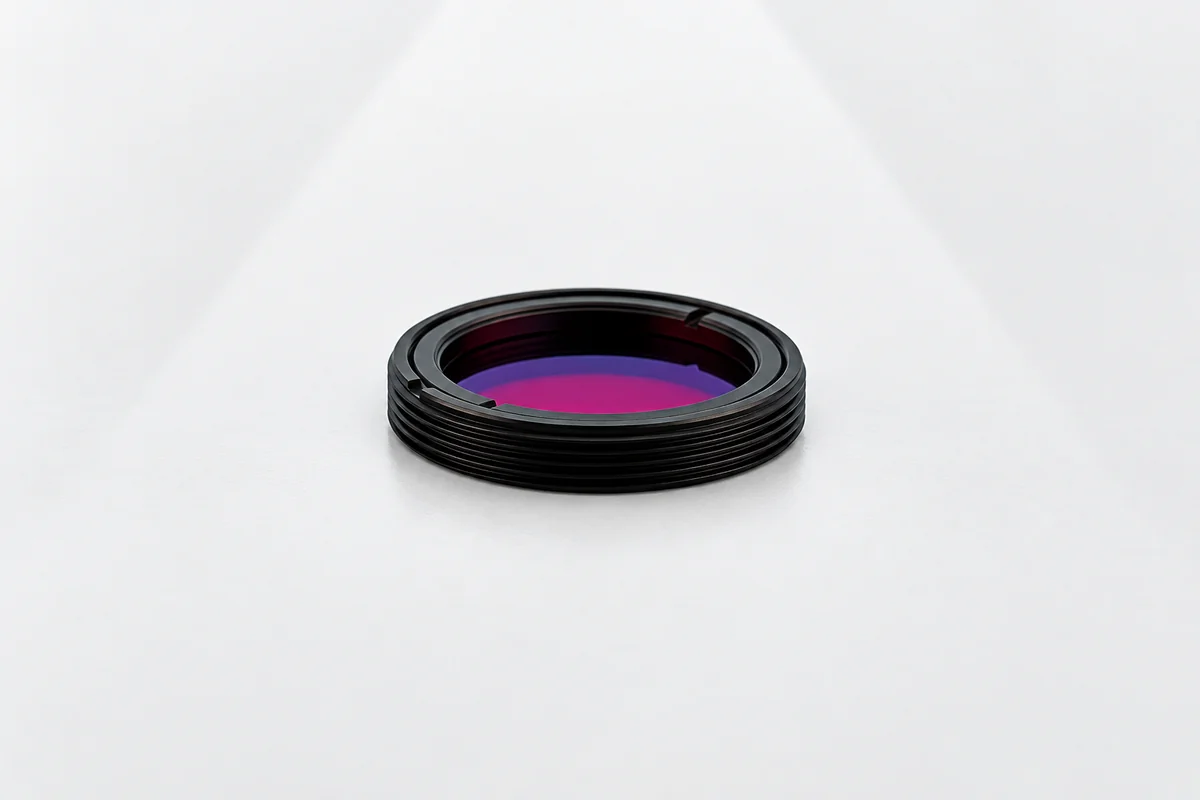
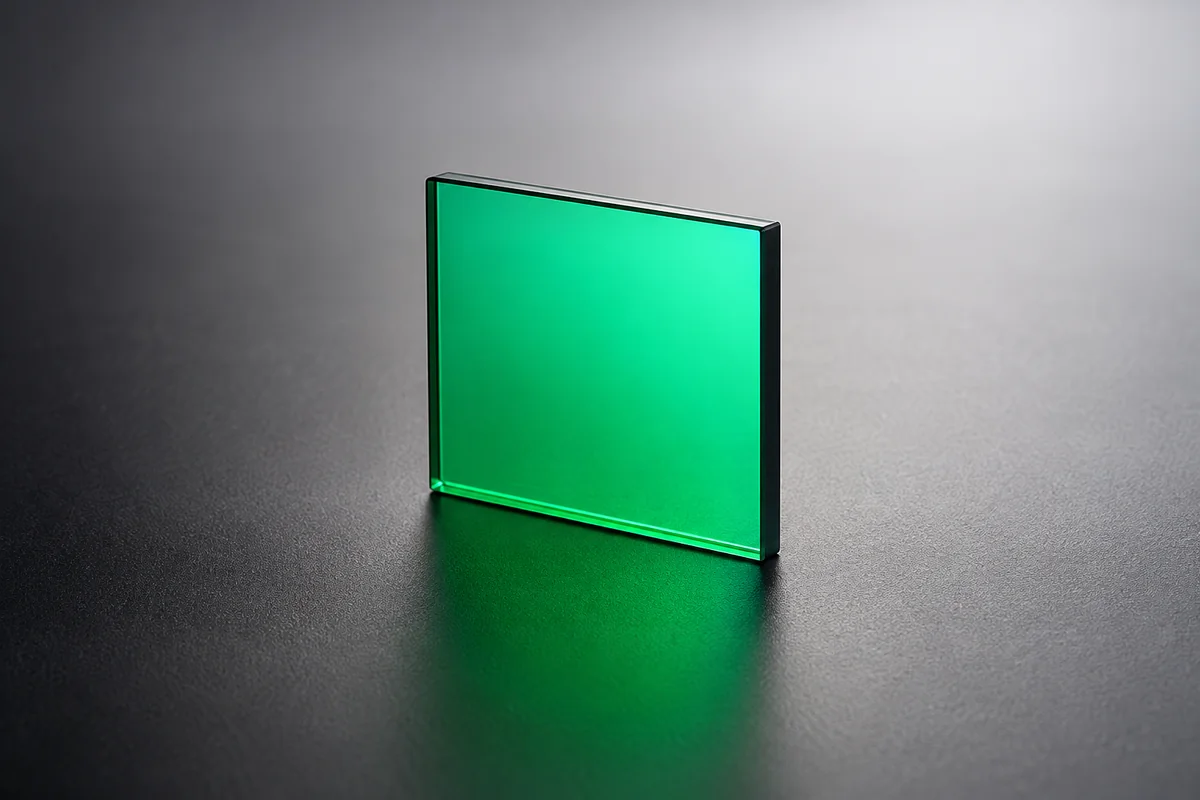
Get a visible bandpass filter quote
Tell us the light source or laser line, the color you need to isolate, the camera and the size, and we will match a band and width or quote a custom filter.
How a Color Filter Creates Contrast
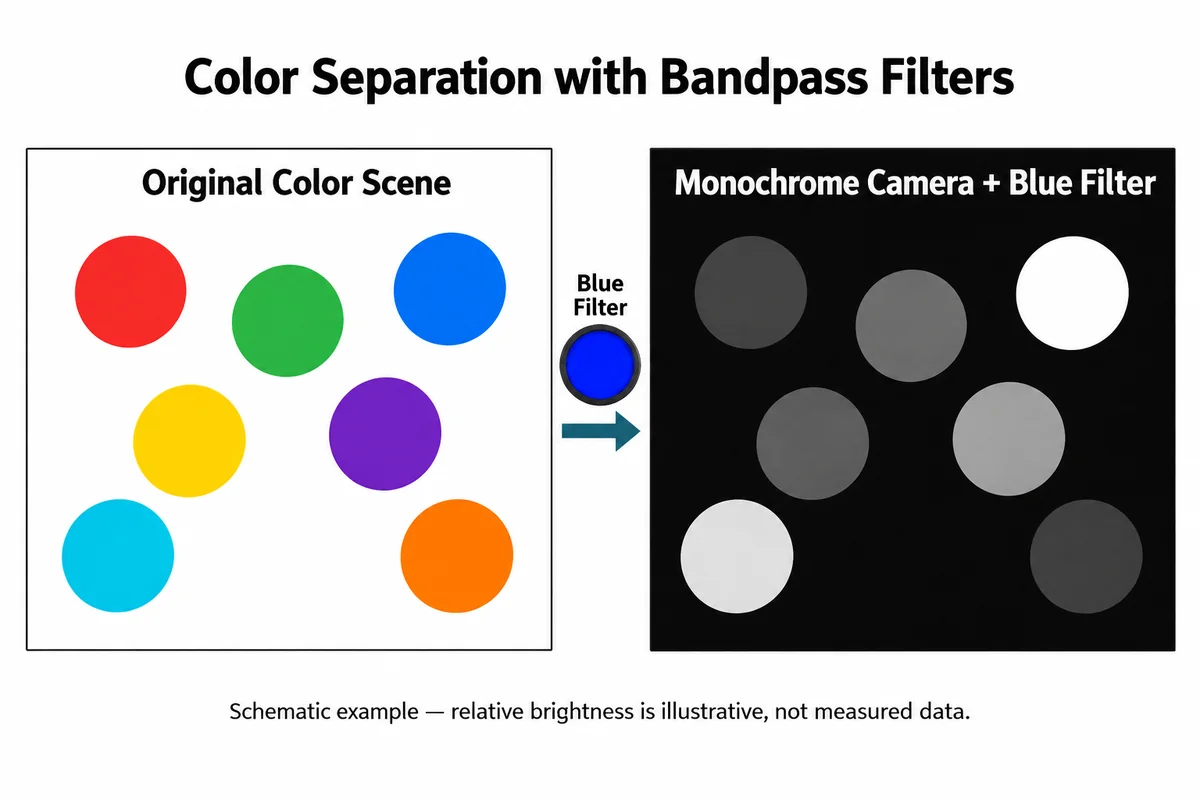
On a monochrome camera, a visible bandpass filter turns color into brightness. A feature the same color as the filter appears bright; a feature in the opposite color appears dark. A red date code on a green carton almost disappears through a red filter and turns black through a green one, so the green filter is the one that makes it readable.
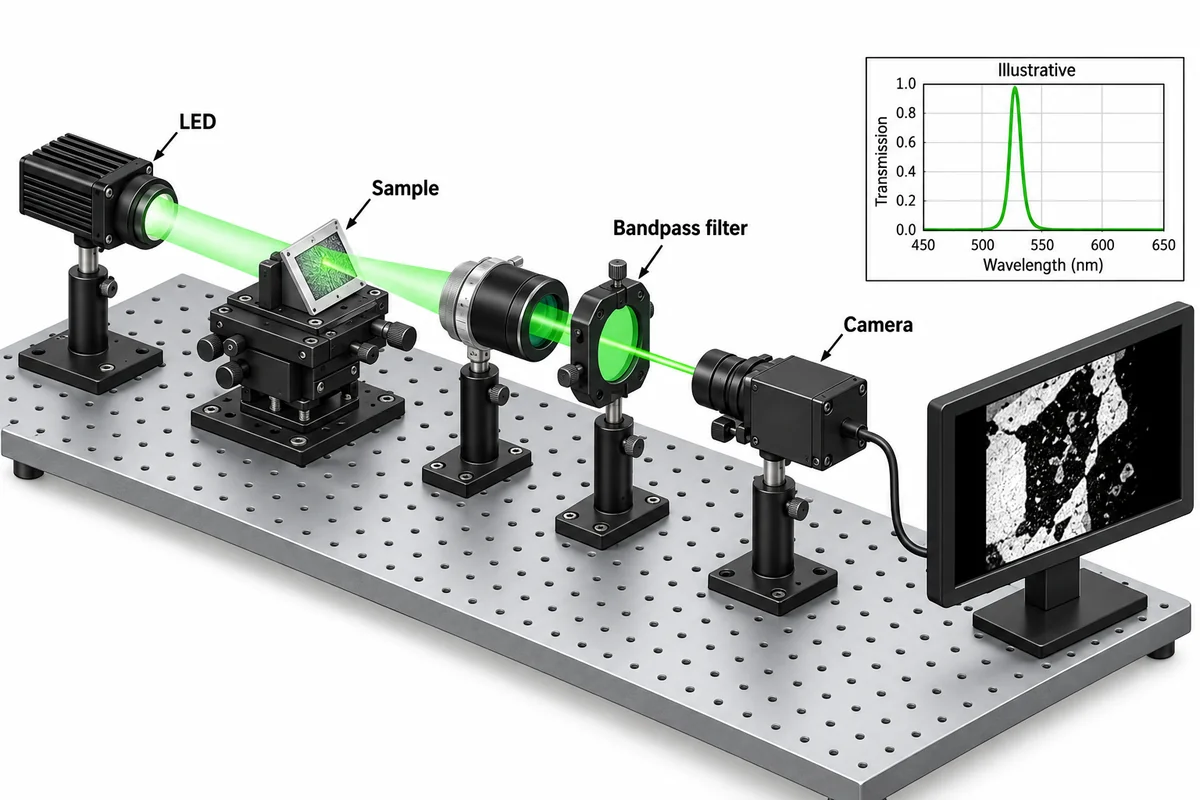
Pairing the filter with an LED of the same color does a second job: the camera sees the LED light and very little of the factory lighting or sunlight around it. That is why most machine vision systems use a colored LED and a matching bandpass filter rather than white light.
Choose the width by the source. Broadband and narrow filters suit LEDs, whose output spreads over tens of nanometers; interference filters suit laser lines. The same rule applies in the near-infrared.
Which Visible Band for Your Application?
Machine vision with colored LEDs
Match the filter to the LED: BP450 or BN450 for blue, BP525 or BN520 for green, BP635 or BN630 for red. The narrow BN filters reject more ambient light at ±7 nm.
Laser line isolation
Interference filters held to ±5 nm cover common visible laser lines: Bi450 for 445–450 nm diodes, Bi525 for 532 nm, Bi632 for 633 nm and Bi650 for 650 nm red diodes.
Fluorescence emission
Narrow and interference filters isolate an emission band from the excitation light: Bi450 for blue emitters such as DAPI, Bi520 or BN520 for green emitters such as FITC and GFP, Bi615 for orange-red emitters.
Colorimetry and RGB separation
Three broadband filters, such as BP450, BP525 and BP635, split light into blue, green and red channels for color measurement on a monochrome sensor.
Whole visible band
The absorptive BP485 passes 380–585 nm, and the BP550 passes 405–690 nm while blocking UV and near-IR, for cameras that need all visible light and nothing else.
Standard Visible Bands
Pass ranges by color and width. Peak transmission is 90% or higher on most broadband filters and 85–90% on narrow and interference filters.
| Color | Broadband (BP, ±10 nm) | Narrow (BN, ±7 nm) | Interference (Bi, ±5 nm) |
|---|---|---|---|
| Indigo | BP450: 425–470 nm | BN450: 435–465 nm | Bi450: 445–465 nm |
| Blue | BP470: 425–495 nm | BN470: 460–490 nm · BN485: 480–490 nm · BN490: 475–500 nm | — |
| Cyan | BP505: 485–550 nm · BP500: 440–555 nm | — | — |
| Green | BP525: 500–555 nm | BN520: 510–545 nm · BN532: 525–550 nm · BN535: 520–545 nm | Bi520: 515–525 nm · Bi525: 518–538 nm · Bi550: 535–558 nm |
| Orange and amber | BP590: 560–600 nm | BN595: 580–610 nm | Bi615: 605–620 nm |
| Light red | BP635: 615–645 nm | BN630: 625–645 nm | Bi632: 625–640 nm |
| Red and dark red | BP660: 640–680 nm | BN660: 645–675 nm | Bi650: 643–665 nm · Bi685: 675–692 nm |
| Whole visible | BP485: 380–585 nm (absorptive) · BP550: 405–690 nm | — | — |
The number in a part name is a nominal color, not always the band center: the BP505 is centered near 518 nm and the BP590 near 580 nm. Specify the pass range you need, and we will confirm the part against it.