
Shortpass Filters (IR-Cut)
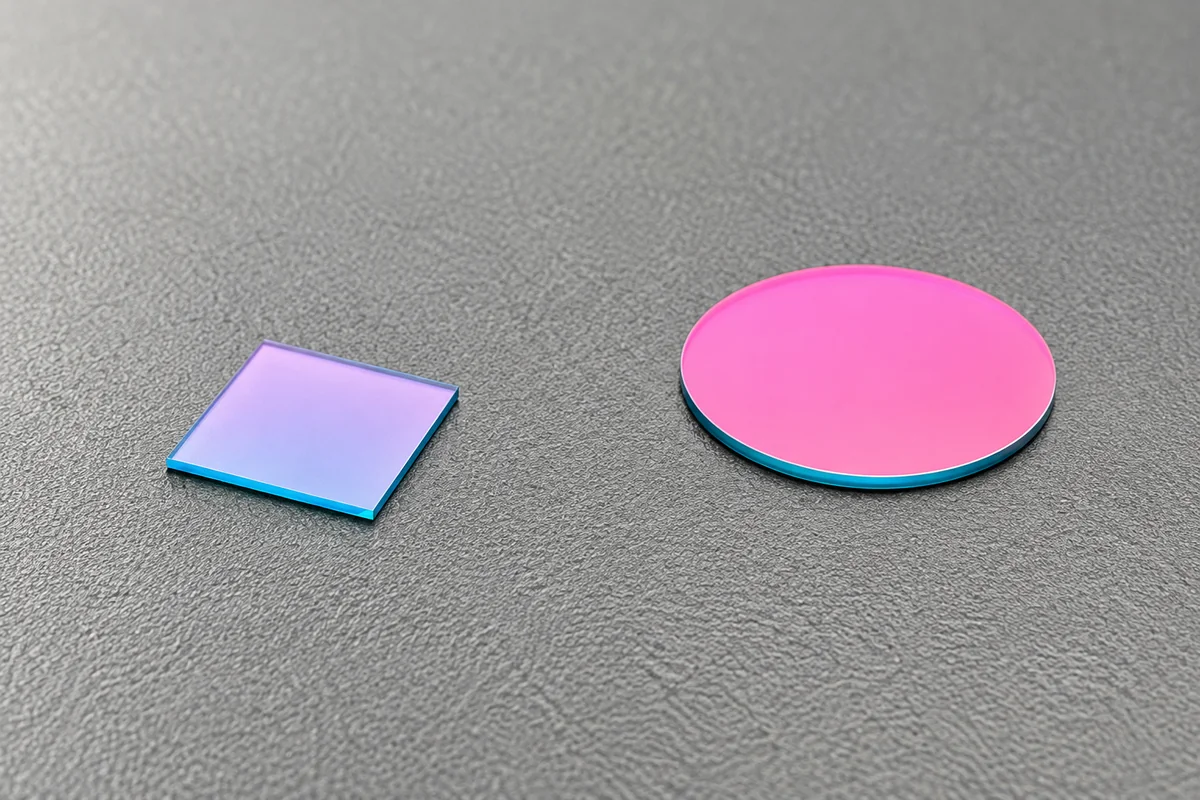
Shortpass filters, also called IR-cut filters, transmit visible light and block near-infrared above a set cut-off. We supply dichroic shortpass filters with 50% cut-off points from 510 nm to 910 nm, held to ±10 nm on most types, for color cameras, machine vision, fluorescence excitation and heat control under high-intensity light.
Capabilities
Cut-off range
510 nm to 910 nm · 50% point, ±10 nm typical
Pass band
From 340 nm on SP510 · To 905 nm on SP910

Coating
Hard dielectric, reflective · UV + NIR block options

Surface quality
Double-side polished · 40/20 scratch-dig

Angle of incidence
Designed for 0° or 45° · Set to your optical path

Mounting
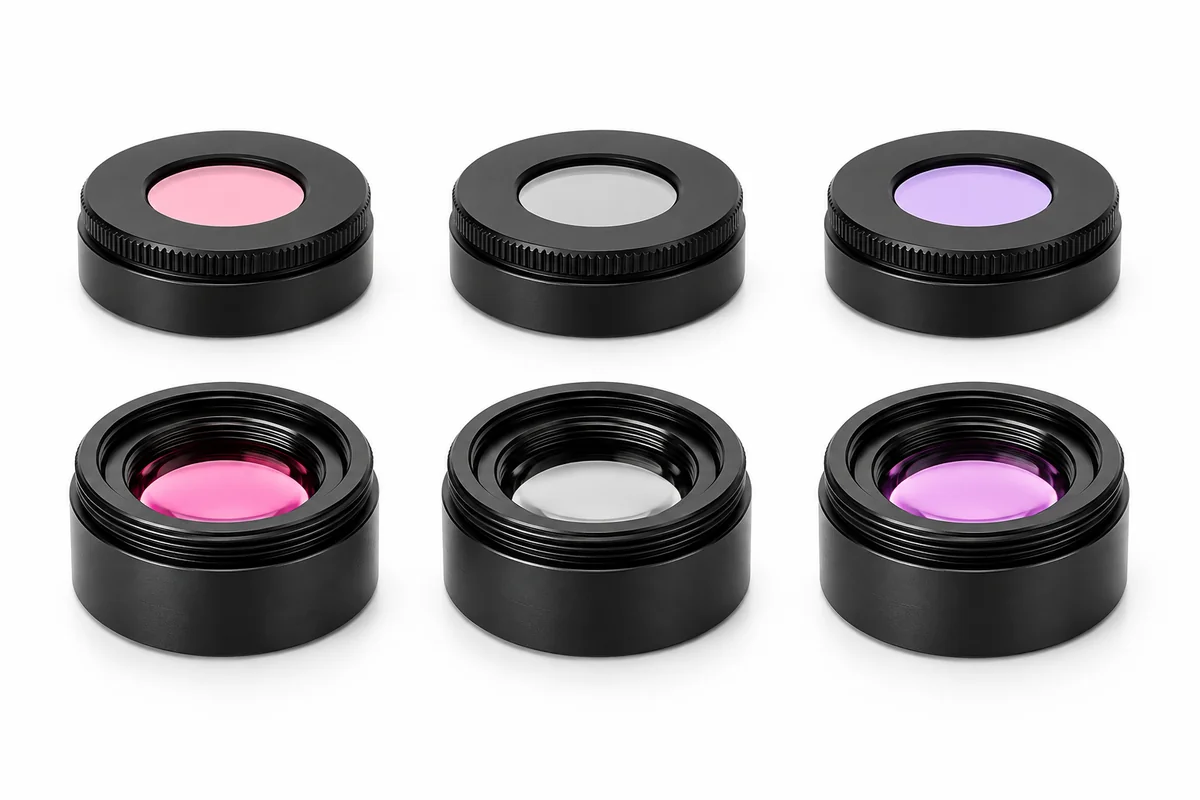
Threaded, C-mount, slip · Custom sizes
Gallery
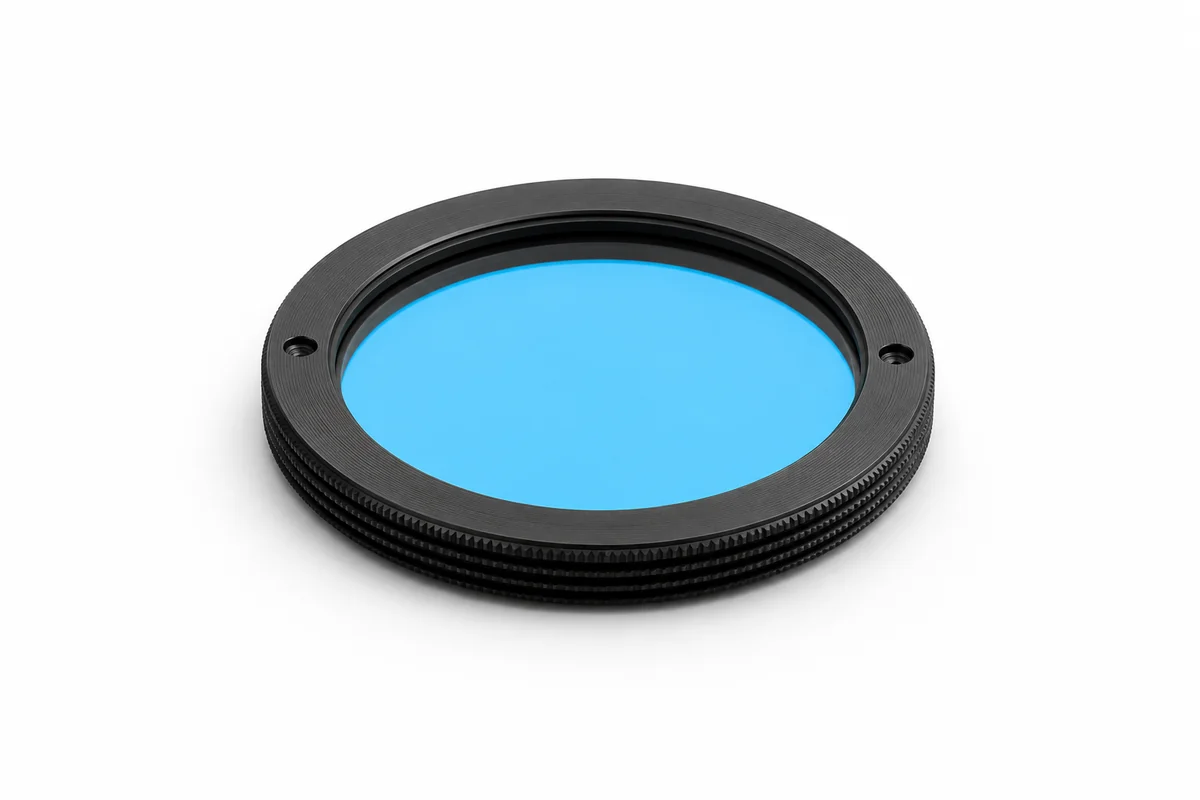
Get an IR-cut filter quote
Tell us the sensor, the wavelengths to keep and block, the angle and the mount, and we will match a cut-off or quote a custom filter.
Which Cut-Off Does Your Sensor Need?
Choose the cut-off by the longest wavelength your sensor should still see.
True color imaging
The SP645 and SP650 cut off at 645–650 nm, so a color camera renders reds without the pink-purple cast that near-IR adds.
Visible light without UV or IR
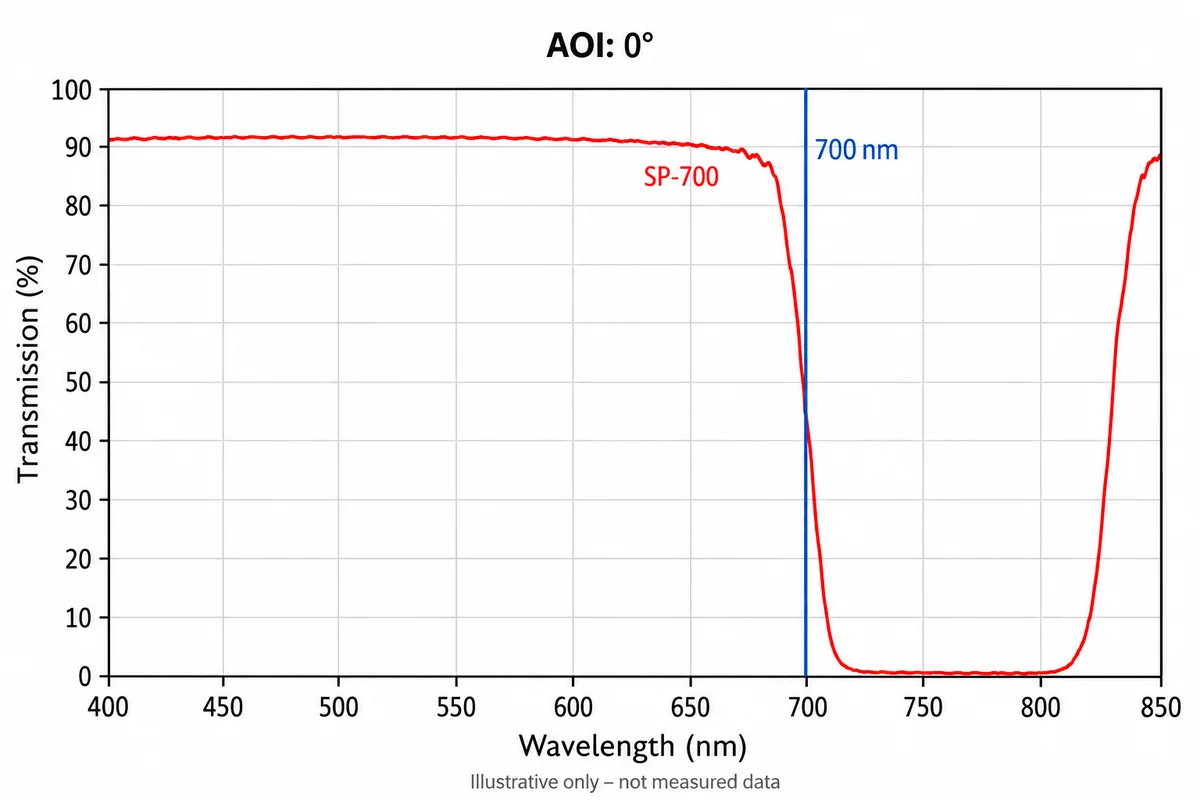
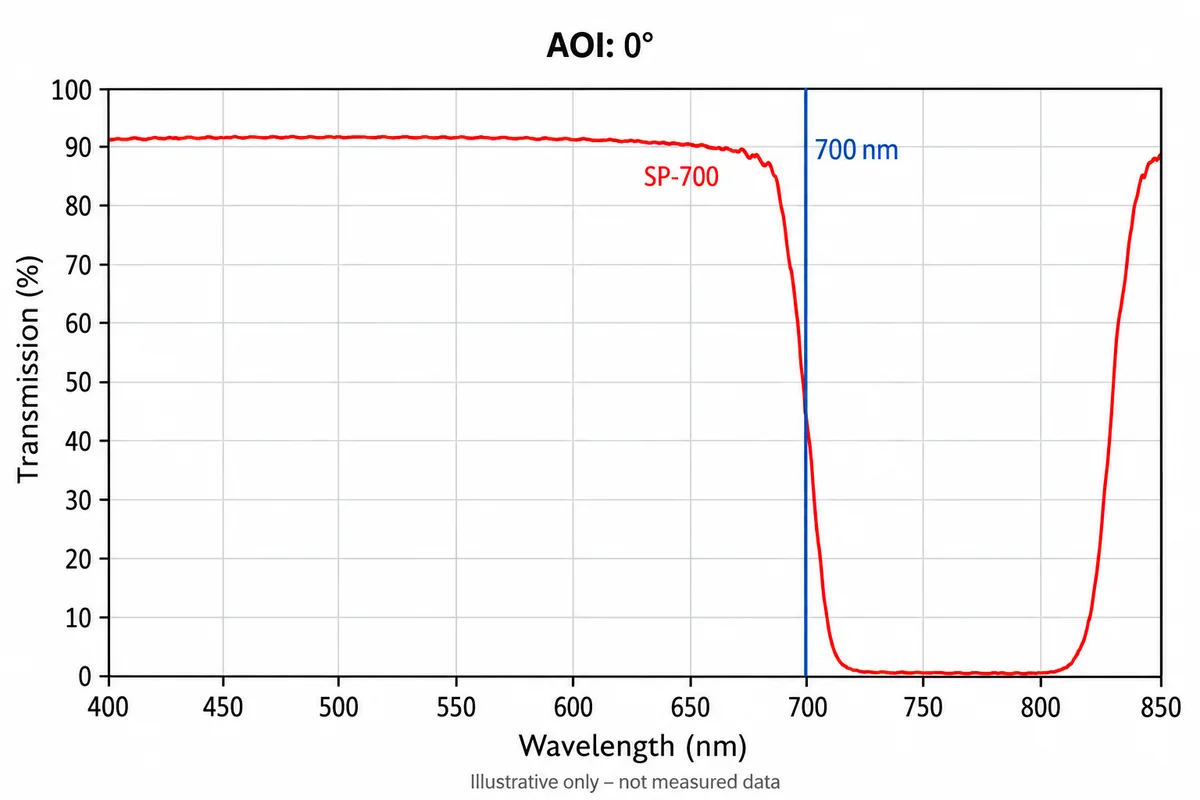
The SP700 passes 405–690 nm and blocks both UV below the band and near-IR from 700 nm.
Full visible, neutral look
The SP730 passes 400–710 nm and blocks from 730 nm, so the filter itself looks colorless.
Visible plus 850 nm illumination
The SP910 passes 420–905 nm, keeping 850 nm LED light while blocking longer near-IR. The SP785 and SP870 set the edge lower for multispectral bands.
Fluorescence excitation
The SP510 passes 340–500 nm and blocks from 510 nm, cleaning up blue and near-UV excitation light before it reaches the sample.
High-intensity light
The SP701 and SP713 are extended hot-mirror designs that reflect near-IR instead of absorbing it; the SP713 blocks out to 1330 nm.
Three Numbers to Check on an IR-Cut Filter
Plan for the cut-off tolerance as well as the cut-off. Most of our shortpass filters are held to ±10 nm at the 50% point, and the pass band ends 5–20 nm below it. On an SP650, keep the wavelengths you need below about 630 nm; if the red channel matters up to 650 nm, step up to the SP700.
Check how far the blocking extends. Silicon camera sensors respond out to about 1100 nm, so an IR-cut filter for a silicon camera must block that far. A design that reflects only to 950 nm leaves a 950–1100 nm leak; extended designs such as the SP713 block to 1330 nm.
State the angle of incidence. Dichroic filters are designed for a specific angle, and the edge moves to shorter wavelengths as the angle increases. A filter in front of a camera lens is built for 0°; one folded into a projector or illumination path is often built for 45°.
Standard Shortpass Cut-Offs
| Model | Pass range | Cut-off (50%) | Tolerance | Type |
|---|---|---|---|---|
| SP510 | 340–500 nm | 510 nm | ±10 nm | Blue and near-UV pass |
| SP651 | 355–635 nm | 635 nm | ±10 nm | Near-UV and visible pass, red and NIR block |
| SP645 | 400–640 nm | 645 nm | ±10 nm | Red and NIR block |
| SP650 | 400–640 nm | 650 nm | ±10 nm | Red and NIR block |
| SP700 | 405–690 nm | 700 nm | ±10 nm | UV and NIR block |
| SP701 | 410–690 nm | 705 nm | ±10 nm | Extended hot mirror |
| SP713 | 420–695 nm | 700 nm | ±10 nm | Extended hot mirror, blocks to 1330 nm |
| SP730 | 400–710 nm | 730 nm | ±15 nm | Colorless NIR block |
| SP785 | 425–770 nm | 785 nm | ±10 nm | NIR block |
| SP870 | from 415 nm | 870 nm | ±10 nm | Multispectral NIR block |
| SP910 | 420–905 nm | 910 nm | ±10 nm | NIR block |
Other cut-offs, sizes and angles are made to order.
Shortpass Filter Questions
Is a shortpass filter the same as a hot mirror?
A hot mirror is a reflective shortpass filter: it transmits visible light and reflects near-IR. The term is used mostly for lamps, projectors and illumination paths, where the filter often sits at 45°. For camera and sensor use, the same coating is sold as an IR-cut or shortpass filter at 0°.
Reflective or absorbing IR-cut filter?
A dichroic filter reflects near-IR, so it stays cooler under high-intensity light and gives a sharp edge. Absorbing heat-control glass such as KG types has a gradual edge but does not shift with angle, which suits wide-angle lenses. For a lamp or projector, choose the reflective filter.
Can a shortpass filter block UV as well?
Yes. The SP700 blocks UV below its 405 nm pass band and near-IR from 700 nm. If you need near-UV, the SP651 and SP510 pass from 355 nm and 340 nm.
Can I build a bandpass filter from a shortpass?
Pair it with a longpass filter: the longpass sets the lower edge and the shortpass sets the upper edge, and each edge can be changed independently.
What sizes and mounts are available?
Filters are cut to round, square or custom shapes and supplied unmounted or in threaded, C-mount and slip mounts.