
Optical Bandpass Filters
Optical bandpass filters pass a defined wavelength band and block the light around it, raising contrast and signal-to-noise in cameras, sensors and analytical instruments. We make bandpass, shortpass and longpass filters from 240 nm in the UV to 1645 nm in the SWIR, with edge filters reaching further, hard-coated on a single substrate, from single prototypes to production runs.
Capabilities

Filter types
Bandpass, dual bandpass · Shortpass, longpass
Spectral range
240–1645 nm bandpass · 170–1850 nm edge filters
Bandwidth
10 nm to over 100 nm · ±5 nm interference types

Substrates
Borofloat®, Gorilla® Glass, acrylic · Fused silica, sapphire

Testing
Transmission and reflection scan · Every part

Volume
Single prototypes · Production runs
Gallery
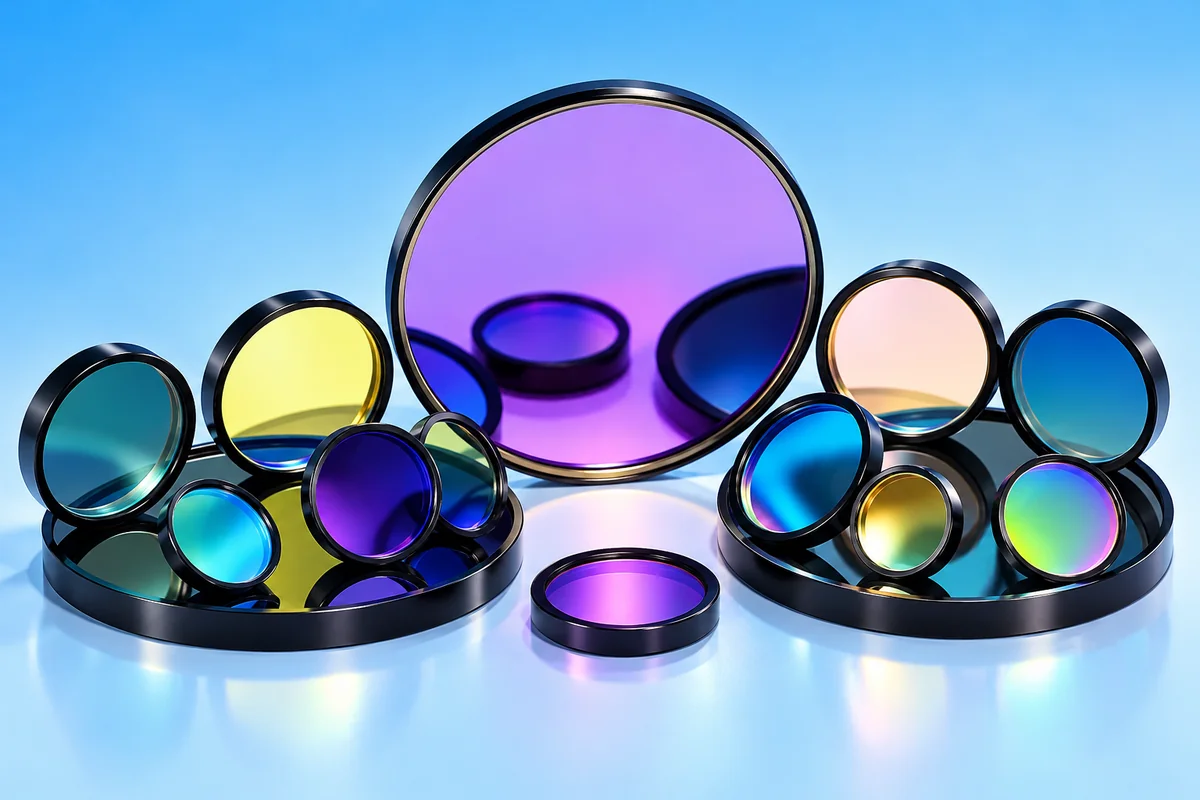
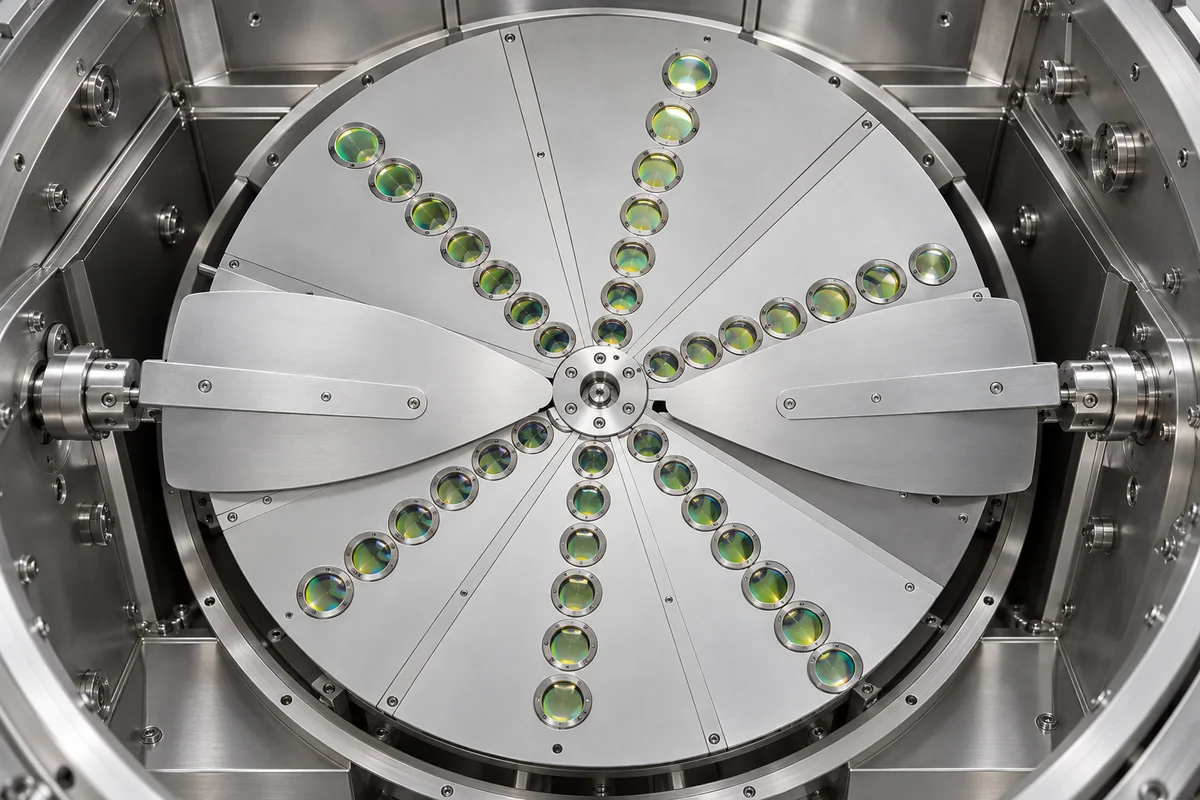
Get an optical filter quote
Tell us the light source, the band to pass, what must be blocked and the detector, and we will match a standard filter or design a custom one.
Filter Types
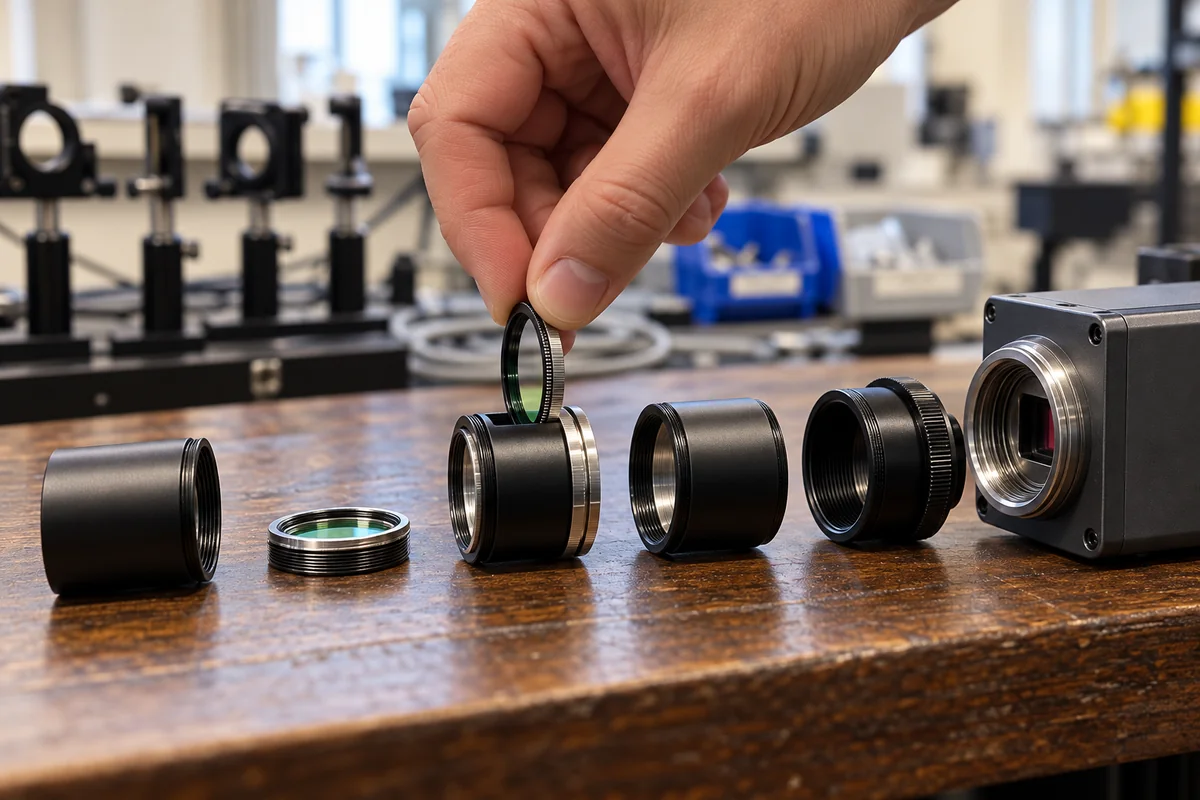
A bandpass filter passes one band; a shortpass passes everything below a cut-off and a longpass everything above a cut-on. Pairing a shortpass with a longpass gives a custom passband when no standard band fits.
Visible Bandpass Filters
One color band from indigo to dark red, for machine vision contrast, laser lines and fluorescence.
- Bands: 425–692 nm
- Widths: 10–70 nm, ±5 to ±10 nm [Visible bandpass filters →]
NIR & Dual Bandpass Filters
Near-IR and SWIR bands for 850 nm and 940 nm LEDs and laser lines, plus visible + NIR dual filters for day-night cameras and NDVI.
- Bands: 680–1645 nm
- Dual: visible or one color + NIR [NIR and dual bandpass filters →]
UV Bandpass Filters
Deep- and near-UV bands for 254 nm, 365 nm and 385 nm sources, fluorescence and inspection.
- Bands: 240–400 nm
- Substrates: fused silica, sapphire, Borofloat® [UV bandpass filters →]
Shortpass Filters (IR-Cut)
Visible pass with near-IR blocked, for color cameras and heat control under high-intensity light.
- Cut-off: 510–910 nm, ±10 nm
- Hot-mirror designs blocking to 1330 nm [Shortpass filters →]
Longpass Filters
UV-blocking, near-IR, SWIR and infrared edge filters, plus AR-coated protective windows.
- Cut-on: 170–1850 nm
- Useful range to 12 µm on the LP1850 [Longpass filters →]
What to Specify
These are the numbers that decide whether a filter works in your system.
| Parameter | What to tell us | Why it matters |
|---|---|---|
| Band | Center wavelength and FWHM, or the 50% cut-on or cut-off | Specify the pass range you need, not a part number; names are nominal. |
| Tolerance | Allowed shift of the band or edge | Interference filters hold ±5 nm, narrow ±7 nm, broadband ±10 nm. |
| Light source | LED, laser line or broadband lamp | LEDs need broadband or narrow filters; laser lines suit interference filters. |
| Peak transmission | Minimum in the pass band | Typically 85–90% or more; deep UV drops to about 30% at 254 nm. |
| Blocking | Optical density and how far it must extend | Must cover the whole detector range, to about 1100 nm on silicon sensors. |
| Angle of incidence | 0°, 45° or the lens field of view | Coated edges move to shorter wavelengths as the angle grows. |
| Substrate | Glass type, or the conditions it must survive | Borofloat® for most bands, Gorilla® Glass for impact, acrylic for low weight, fused silica or sapphire below 340 nm. |
| Size and surface | Shape, dimensions, thickness | Round, rectangular or custom; double-side polished to 40/20 scratch-dig. |
| Mounting and finish | Threaded, C-mount, slip or unmounted | Unmounted parts can take VHB adhesive, oleophobic coating or protective film. |
| Environment | Temperature range, outdoor or cleanroom use | Hard-coated single-substrate filters hold their spectrum across temperature. |
From Prototype to Production
- 01
Review the specification
We match your band, blocking and angle to a standard filter, or design a custom coating when none fits.
- 02
Ship a prototype
Standard filters ship as samples in 1–2 days, so you can test them in your optics before committing.
- 03
Coat and fabricate
Filters are cut to shape, polished on both faces, hard-coated on a single substrate and mounted or finished as specified.
- 04
Measure every part
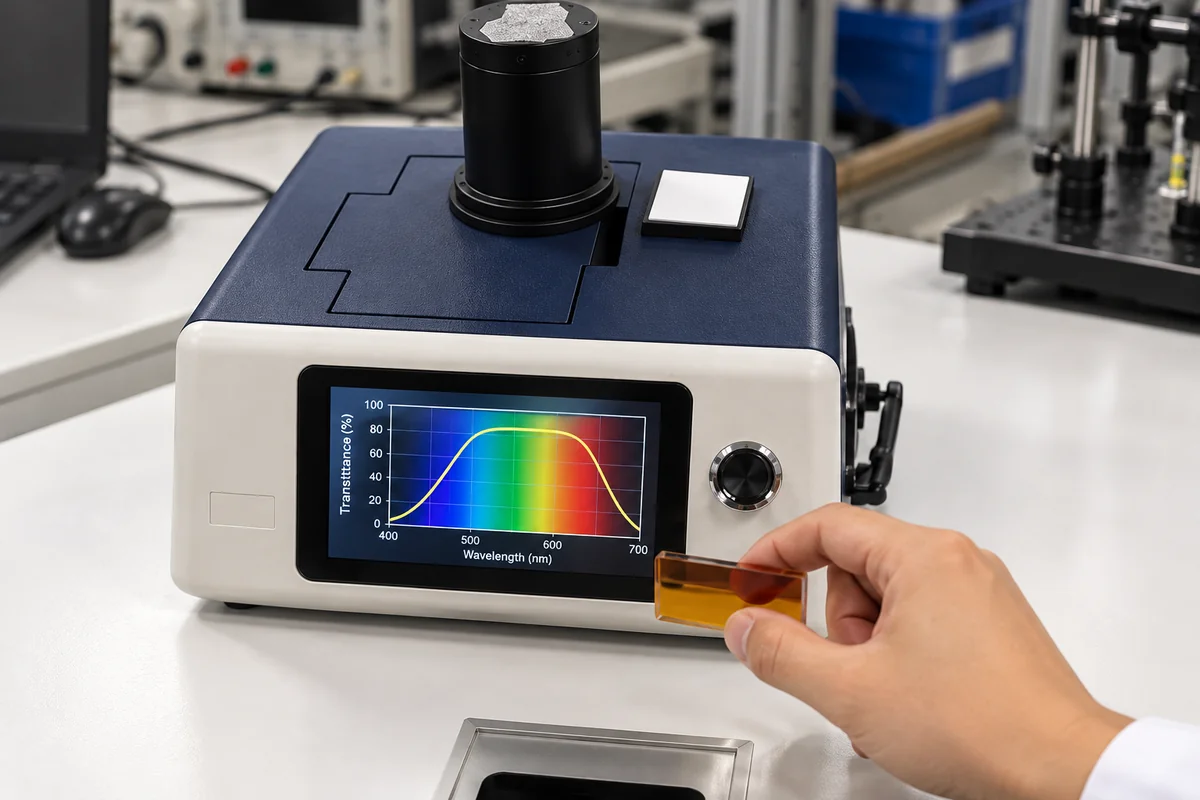
Our Cary and Shimadzu spectrophotometers measure hundreds of parts at a time, and each filter ships with its full transmission and reflection scan.
- 05
Move to production
Custom filters typically ship in 3–4 weeks, with the same scan supplied on every repeat order.