
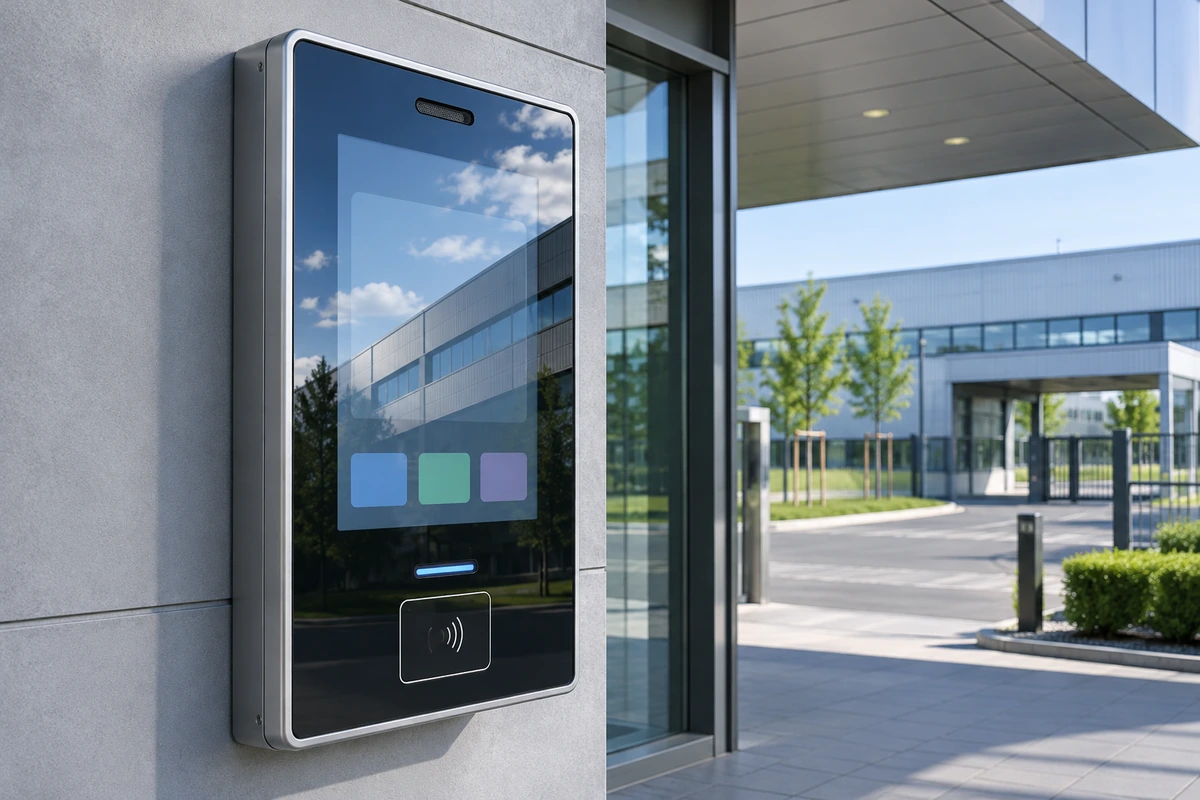
There are two main ways to deal with reflections on glass:
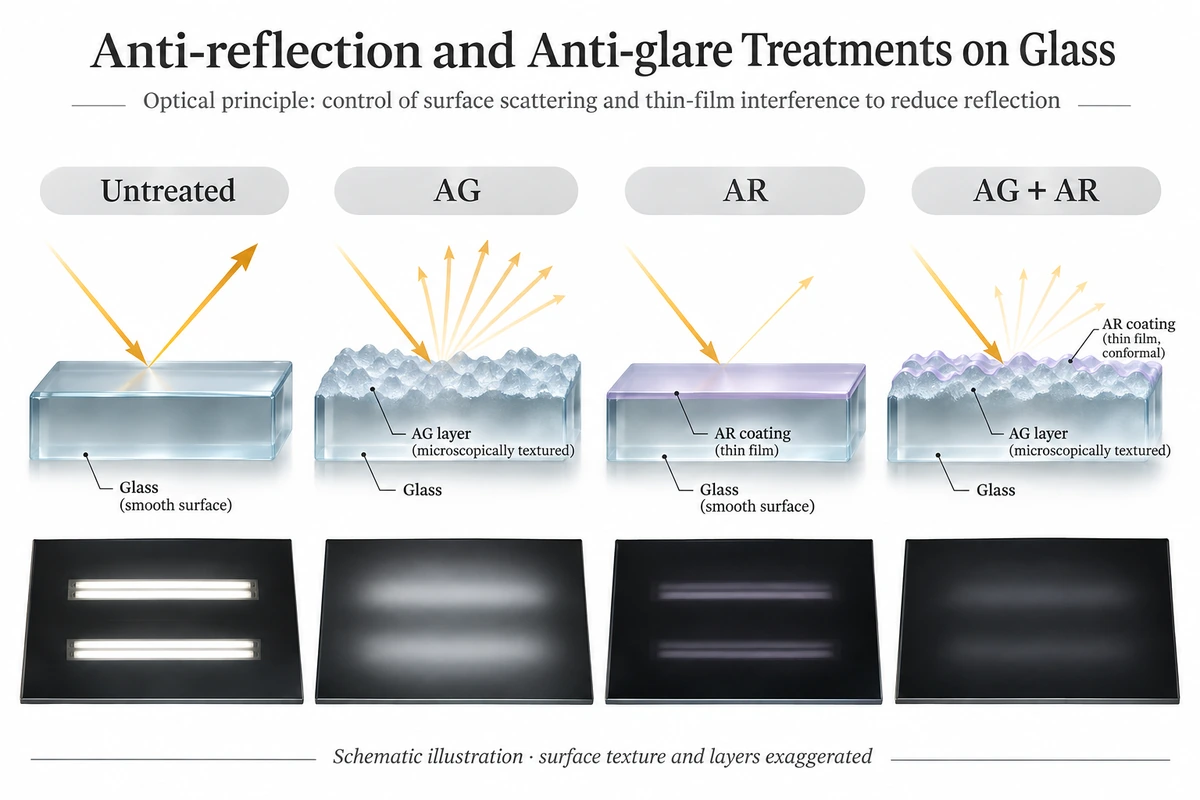
- Anti-glare (AG) glass has a very fine, frosted-feeling texture on its surface. It doesn't stop reflections; it blurs them, so a bright lamp shows up as a soft glow instead of a sharp image.
- Anti-reflective (AR) glass has an ultra-thin coating that cancels most reflections. The glass stays clear and glossy, and far less light bounces back.
In one line: AG changes what a reflection looks like; AR makes the reflection much smaller.
Why Plain Glass Reflects at All
Every time light passes from air into glass, a little of it bounces back. For ordinary glass that's about 4% at each surface. A sheet of glass has two surfaces, so about 8% of the light hitting it comes straight back. That's why a shop window at night works like a mirror.
Four percent sounds small. But a screen's black areas give off almost no light of their own, so even a small reflection of the sky or a ceiling light washes them out to gray.
How Anti-Glare Glass Works
AG glass is usually made by etching the surface with acid to give it a microscopic texture. Some cheaper versions spray on a layer of tiny particles instead. Either way, the rough surface scatters reflected light in many directions.
The result is that you no longer see a crisp mirror image of a window or lamp. You see a soft haze instead, which the eye finds much easier to ignore.
What AG doesn't do is reduce the total amount of reflected light. Etched AG glass reflects roughly 4–7% of light, about the same as plain glass. The reflection is spread out, not removed.
AG comes with two trade-offs:
- The texture slightly blurs the image underneath. On a sharp, high-resolution screen, small text can look a little soft.
- Some AG surfaces cause "sparkle," a grainy glitter that appears when the texture interacts with the screen's pixels. It shows up most on high-resolution displays, and you can only judge it by looking at the actual screen behind the glass.
AG is also measured by how glossy it is. Suppliers usually offer a few levels, from strongly matte to nearly glossy. More matte hides reflections better but blurs the image more.
How Anti-Reflective Glass Works
AR glass carries a stack of extremely thin transparent layers, each thinner than a wavelength of light. Light bouncing off one layer meets light bouncing off the next, and they cancel each other out. A good AR coating cuts a surface's reflection from about 4% to under 0.5%.
Because the surface stays smooth, the image stays perfectly sharp. That's why AR is used on camera lenses, eyeglasses, museum display cases and high-end monitors.
AR has its own trade-offs:
- It costs more than AG.
- Fingerprints are more visible. The skin oil fills in the coating locally, so each smudge shows up as a bright patch. An anti-fingerprint (AF) top coat helps a lot.
- Every AR coating leaves a faint tint in its reflection, often blue or purple, that changes as you tilt the glass.
The Gap Behind the Glass Matters More Than the Coating
There's one thing that often matters more than choosing AR or AG: whether there is air between the cover glass and the screen.
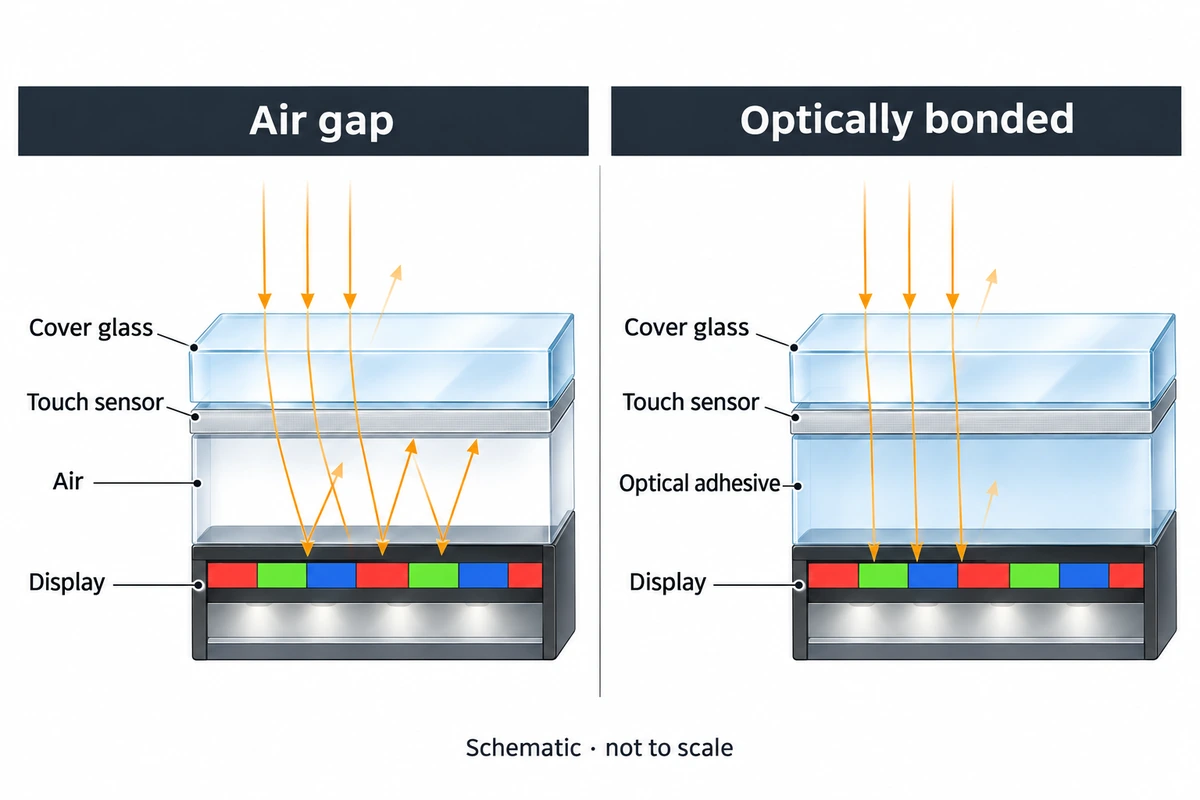
In many devices, the cover glass simply sits in front of the display with a thin air gap behind it. That gap adds two more glass-to-air surfaces, each reflecting about 4%. Together with the front surface, roughly 12–13% of incoming light bounces back before it reaches your eye.
Optical bonding fills that gap with a clear adhesive, so those two inner reflections disappear. Here's what that does in bright daylight, using a simple estimate for a typical 1,000-nit screen:
| Setup | Light reflected | Rough contrast in bright daylight |
|---|---|---|
| Air gap, plain glass | about 12.7% | about 3.5 : 1 |
| Bonded, plain glass | about 4.3% | about 8 : 1 |
| Bonded, AG glass | about 4–7%, blurred | about 5.5–9 : 1 |
| Bonded, AR glass | about 0.5% | about 60 : 1 |
Contrast here means how much brighter white looks than black. Anything around 3:1 looks washed out, while 60:1 looks clear and punchy. These numbers are a simplified estimate meant for comparing options, not lab measurements.
Two things stand out. Removing the air gap does more than adding AG. And AR on a bonded screen is in a different league for outdoor readability.
Which One Fits Where
Indoor touch screens under office or shop lighting, such as kiosks, point-of-sale terminals and machine control panels, usually do best with etched AG plus an anti-fingerprint coating. The reflections there come from ceiling lights, and AG turns them into a soft glow that nobody notices. Etched AG also stands up well to constant tapping and wiping.
Outdoor screens, such as EV chargers, ticket machines and boat displays, need AR, ideally on a bonded display. In direct sun, only AR cuts reflections enough to keep the screen readable. If mirror images of the sun are still a problem, AR and AG can be combined on the same glass.
High-resolution screens viewed up close, such as medical monitors, test instruments and design displays, lean toward AR, or a very light AG that keeps text sharp and doesn't sparkle.
Display cases and picture framing use AR, because it keeps colors true and makes the glass almost disappear.
Medical and lab touch screens that are wiped with disinfectant many times a day usually use etched AG with a tough anti-fingerprint coating. It's worth checking that the coating survives the specific cleaning chemicals used.
How to Compare Samples Yourself
Datasheets help, but reflections are something you judge with your eyes. If you're choosing between options, ask for small samples and try this:
- Put the samples side by side under one bright lamp, or near a window. Tilt them until the lamp's reflection falls on each one. Plain glass shows a sharp image of the lamp. AG shows a soft glow. AR shows only a faint, tinted reflection.
- Lay each sample on a printed page with small text, and look straight down. AR should look perfectly clear. AG should still be readable but slightly softer; if it isn't, ask for a glossier grade.
- Hold each sample against the actual screen it will cover, showing a white image. Look closely for grainy glitter. If you see it, that AG grade sparkles on your display.
- Touch each sample a few times, then wipe it with a cloth. See how visible the fingerprints are, and how easily they come off.
Ten minutes of this tells you more than a page of numbers. Once you know what you like, a supplier can match it with measurable values such as gloss level for AG and reflectance for AR.
If you'd like help choosing, tell us what the screen is, where it will be used and how bright the light is there, and we'll suggest a few options to try.