
So the real comparison is between soda-lime glass as it comes, called annealed glass, and soda-lime glass after tempering. Same material, very different behavior. Here's how they differ, and when each is the right choice.
What Soda-Lime Glass Is
Soda-lime glass is made mostly from sand (silica), soda ash and limestone, the "soda" and "lime" in its name. It's cheap, clear and easy to produce in large flat sheets, which is why it makes up the vast majority of glass in the world.
Fresh from production, flat glass is cooled slowly and evenly so it has no built-in stress. That's annealed glass. It can be cut, drilled and ground freely, but it breaks fairly easily and, when it does, it breaks into sharp, dangerous pieces.
What Tempering Does
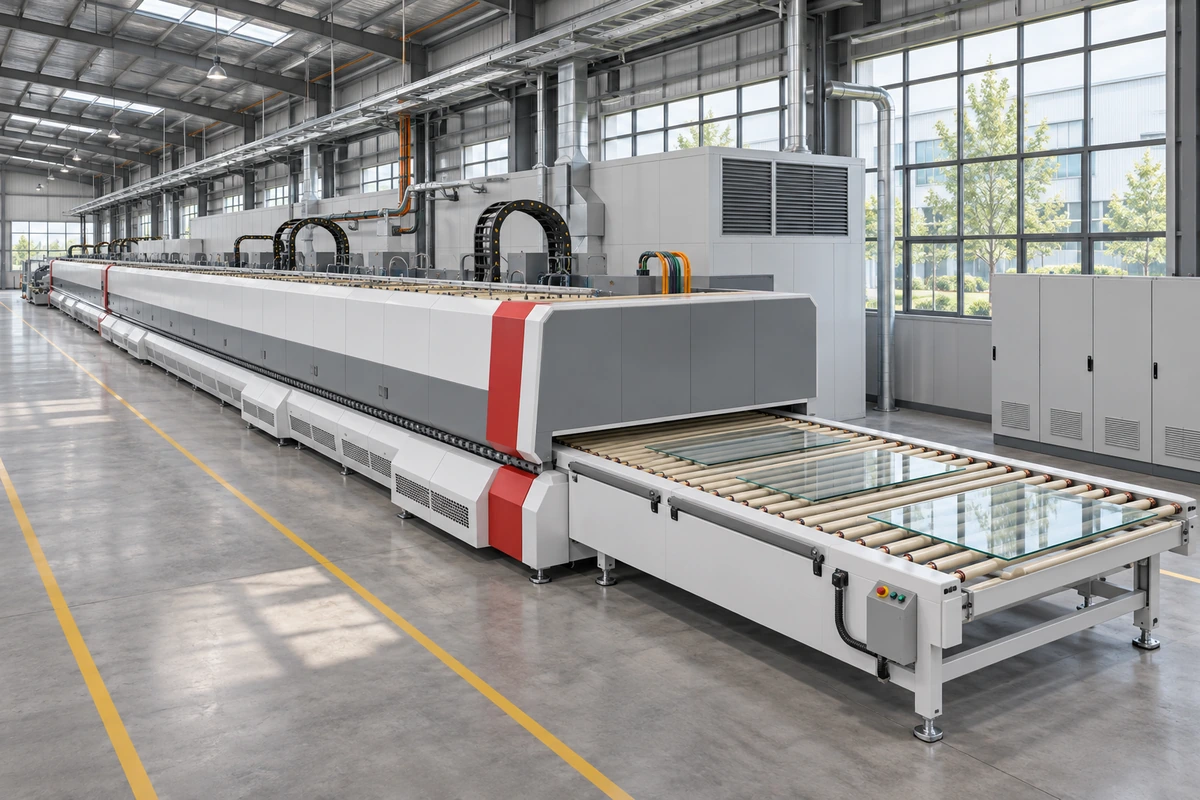
To temper glass, it's cut to its final size, heated to about 620 °C (1,150 °F), then cooled quickly by blasting both faces with air. The surfaces harden first; the core cools and shrinks afterward, pulling the surfaces into compression. That locked-in compression is what makes tempered glass strong.
The North American standard ASTM C1048 requires fully tempered glass to have at least 69 MPa (10,000 psi) of surface compression. Glass makers describe the result as about four to five times stronger than annealed glass of the same thickness.
Side by Side
| Annealed soda-lime | Tempered soda-lime | |
|---|---|---|
| Strength | Baseline | About 4–5× stronger |
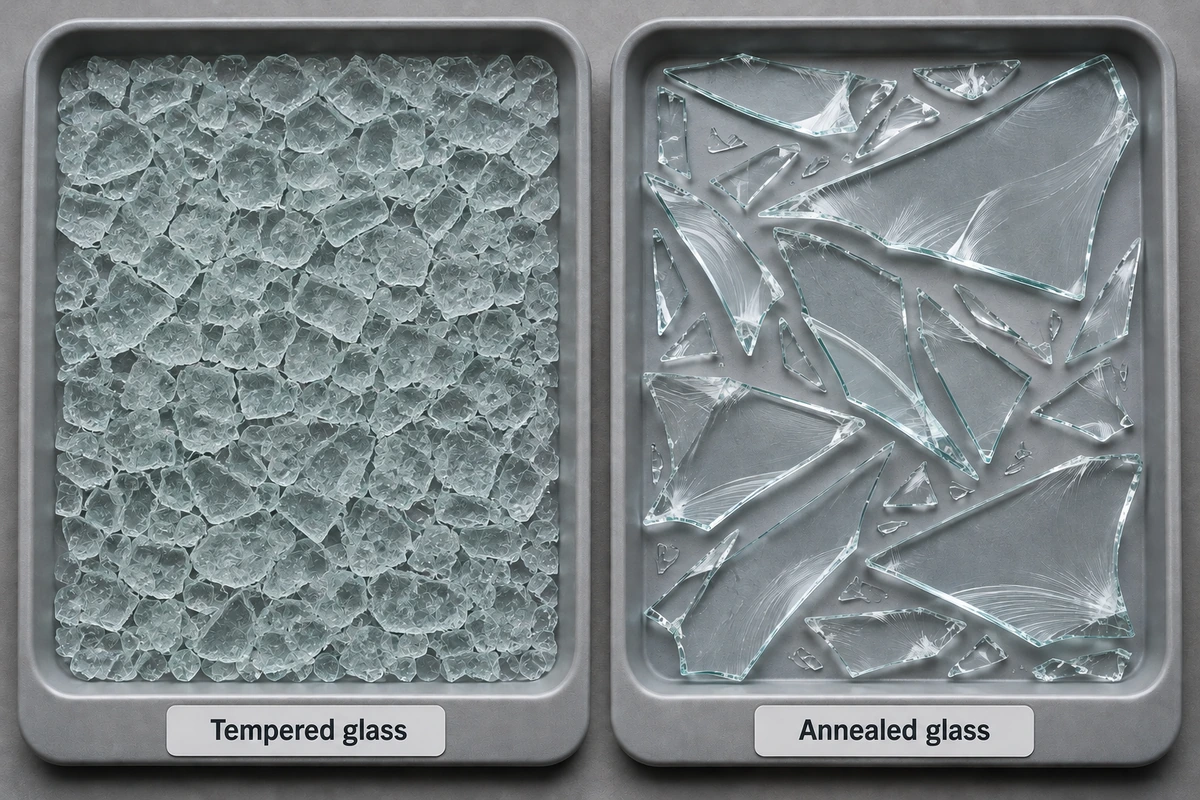
| How it breaks | Large, sharp shards | Small, blunt pieces |
| Temperature difference it handles | About 35–45 °C (63–81 °F) | About 200 °C (360 °F) |
| Can it be cut or drilled afterward? | Yes | No; it shatters |
| Flatness and optics | Very flat | Slight bow and ripple from the process |
| Spontaneous breakage | Not an issue | Small risk from nickel sulfide inclusions |
| Typical thickness | Any | Usually about 3–4 mm and up |
| Cost and lead time | Lowest | Extra process step |
Temperature figures are allowable temperature differences across a pane, from IStructE guidance as published by Saint-Gobain. Annealed glass ranges from about 35 °C with as-cut edges to 45 °C with polished edges.
Breakage: The Biggest Practical Difference
When annealed glass breaks, it forms long, sharp shards that can cause serious cuts. When tempered glass breaks, the stored stress releases all at once and the whole pane crumbles into small, blunt pieces. That's why tempered glass is used as safety glass in doors, shower screens, furniture and many appliances.
There's a trade-off. Because the stress is stored throughout the pane, a deep chip on the edge can make the whole panel shatter at once, sometimes well after the damage happened.
Heat: Tempered Glass Handles Temperature Swings Far Better
Glass cracks from heat mainly when one part gets much hotter than another. Think of sunshine on the middle of a pane while its edges stay cool in the frame, or a hot dish on a cold shelf.
Annealed glass can only handle a temperature difference of roughly 35–45 °C (63–81 °F) across the pane. Tempered glass handles about 200 °C (360 °F). Pilkington rates its toughened glass for continuous use up to 250 °C (480 °F).
That's why oven doors, fireplace screens, lighting covers and glass near heat sources are tempered.
Cutting: Do All the Work First
Annealed glass can be cut, drilled, notched and edged at any time. Tempered glass can't. Cutting or drilling it releases the stored stress, and the pane shatters.
So every hole, cutout and edge finish has to be done before tempering. Once glass is tempered, its size and shape are final. If a measurement is wrong, the only fix is a new piece.
Flatness and Spontaneous Breakage
Tempering softens the glass while it moves through the furnace on rollers, which can leave a slight bow and a faint ripple, called roller wave. It's usually invisible on a clear panel, but it can show in mirrors and in reflective glass viewed at an angle.
Tempered glass also carries a small risk of breaking on its own, months or even years later. The cause is usually a tiny nickel sulfide stone in the glass that slowly expands. A heat soak test after tempering reduces this risk, though it doesn't remove it entirely. Annealed glass doesn't have this problem.
When Annealed Glass Is Fine
Tempering isn't always needed. Annealed soda-lime glass is perfectly suitable when:
- The glass is small and well supported, like picture frames and small cabinet panels
- It sits inside a protective housing where it won't be hit or heated unevenly
- It will be laminated, where the plastic interlayer holds the pieces together if it breaks
- It must be cut or adjusted on site
- Perfect flatness matters more than strength, as in mirrors and some optical uses
When You Need Tempered Glass
Choose tempered glass when:
- People could hit it or fall against it: doors, shower screens, railings, tabletops
- Building codes or product safety rules require safety glazing
- It faces heat or uneven temperatures: ovens, fireplaces, lighting, sunny facades
- It's a panel or cover that will be knocked in daily use
One limit to keep in mind: thermal tempering doesn't work well on thin glass, below about 3 mm. Thin covers, such as touch screens, are usually chemically strengthened instead. That's a different process, done in a salt bath, that also works on soda-lime glass.
Common Questions
Is tempered glass a different material from soda-lime glass? Usually not. Most tempered glass is soda-lime glass that has been heat-treated. Other glasses, such as aluminosilicate, can be strengthened too, but standard tempered glass is soda-lime.
Is tempered glass more scratch-resistant? Not noticeably. Tempering makes glass stronger, not harder. Its surface scratches about as easily as annealed glass.
Can you tell tempered glass from annealed glass by looking? Sometimes. Through polarized sunglasses, tempered glass often shows a faint pattern of dark spots or stripes, caused by its built-in stress. Pilkington notes this "strain pattern" can be visible in slightly polarized light. Safety glass is also often marked with a small stamp in one corner.
Can tempered glass be cut to size later? No. It has to be ordered at the exact final size, with all holes and edges already finished.
Is tempered glass heat-proof? It handles far larger temperature differences than annealed glass, and continuous temperatures up to about 250 °C, but it isn't designed for direct flame or very high heat. Fireplaces and stoves often use glass-ceramic instead.
If you're not sure whether a part needs tempered glass, tell us what it's for and how it's mounted, and we'll help you decide.