
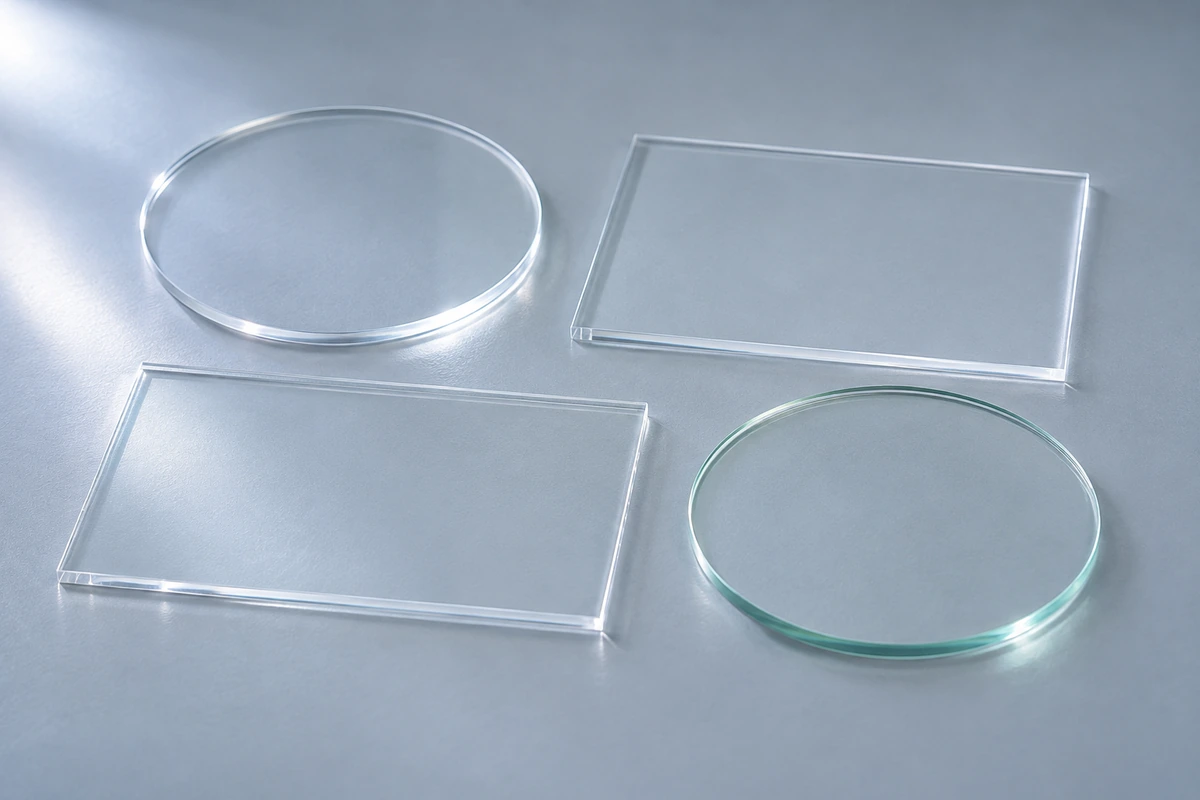
The good news is that the choice usually comes down to one question: what will this glass have to put up with? Heat, impact, scratching, sunlight or simply being looked at? Start there, and the right family of glass is usually obvious.
The Short Version
| Application | Usual glass | Why |
|---|---|---|
| Phone, tablet and handheld screens | Aluminosilicate, chemically strengthened | Thin, light and tough against drops and scratches |
| Touch panels, smart-home panels, HMIs | Aluminosilicate or soda-lime, chemically strengthened | Strength at thin sizes; soda-lime when budget matters |
| Appliance fronts, lighting covers, shelves | Soda-lime, tempered | Low cost, strong, safe break pattern |
| Display cases, signage, solar panels, thick clear panels | Low-iron (ultra-clear) soda-lime | Higher clarity, no green tint |
| Oven windows, lab glassware, lamp covers | Borosilicate | Handles heat and sudden temperature changes |
| Fireplace and stove windows, cooktops | Glass-ceramic | Barely expands with heat; survives very high temperatures |
| UV optics, sensors, high-temperature windows | Fused silica (quartz glass) | Transmits deep UV; almost zero thermal expansion |
| Watch faces, camera lens covers | Sapphire | Extremely scratch-resistant (technically a crystal, not glass) |
The sections below explain the thinking behind each row.
Screens and Touch Panels: Strength at Thin Sizes
Phone screens, tablets, smartwatches and handheld devices need glass that's thin, light and survives being dropped. That's the job of aluminosilicate glass, the family that includes Corning's Gorilla Glass and Panda glass from China. It's soaked in a hot salt bath that squeezes its surface into compression, a process called chemical strengthening, which makes it several times stronger than ordinary glass of the same thickness.
For touch panels that don't get dropped much, like thermostats, appliance controls or factory screens, chemically strengthened soda-lime glass is a lower-cost option. It's the same ordinary glass used in windows, strengthened the same way, just not as tough as aluminosilicate.
One note for anyone still specifying AGC's Dragontrail: AGC announced in late 2025 that it's leaving that business, so new designs should plan around another grade.
Everyday Panels: Tempered Soda-Lime Glass
Most glass around us is soda-lime glass: windows, bottles, picture frames. For panels that need to be strong and safe, such as oven doors, refrigerator shelves, lighting covers and appliance fronts, it's usually thermally tempered: heated and then cooled quickly with air.
Tempered glass is roughly four times stronger than untreated glass. If it does break, it crumbles into small, blunt pieces rather than sharp shards. It's affordable and widely available. Its limit is thickness: tempering only works well on glass about 3 mm (1/8 in) and thicker.
When Clarity Matters: Low-Iron Glass
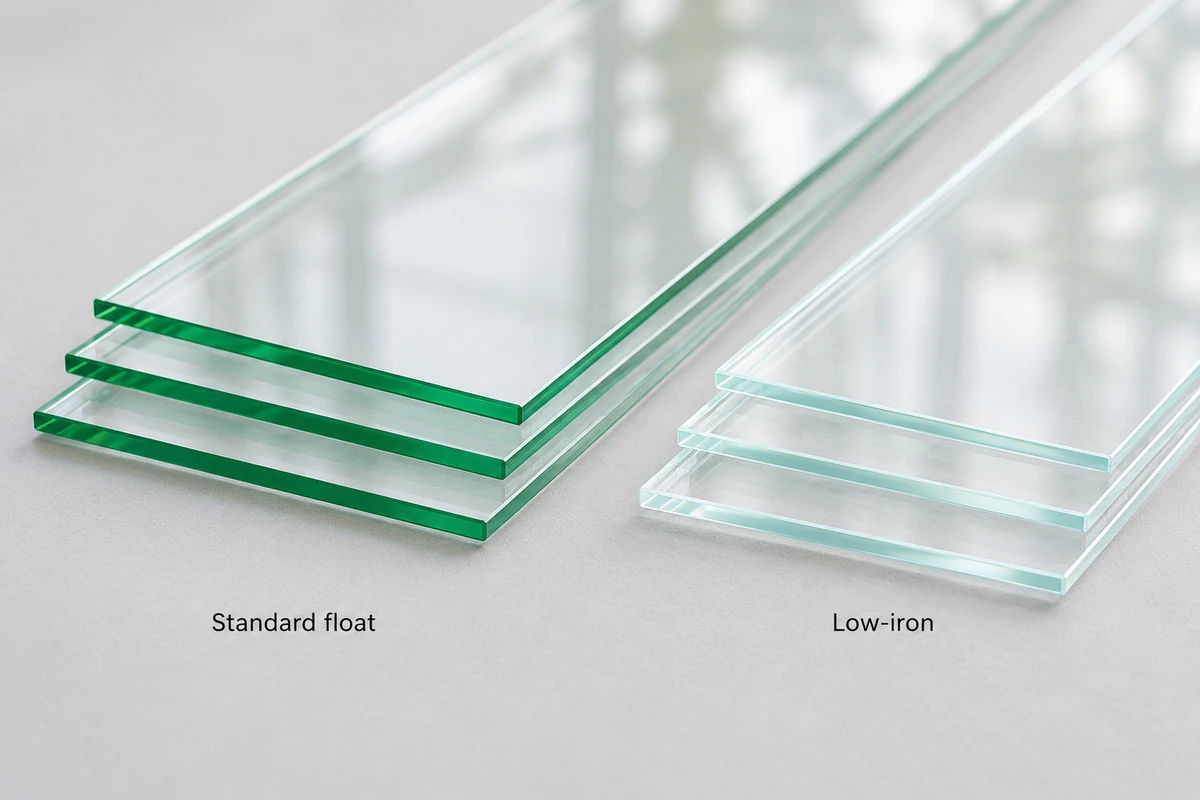
Ordinary clear glass has a faint green tint from small amounts of iron. You rarely notice it in a thin sheet, but look at the edge of a thick glass shelf and you'll see it clearly.
Low-iron glass, often sold as ultra-clear, removes most of that iron. The difference grows with thickness. Vitro's figures show it well:
- At 1/8 in (about 3 mm), standard clear glass lets through about 90% of visible light and low-iron about 91%. You'd hardly notice the difference.
- At 3/4 in (about 19 mm), clear glass drops to about 83%, while low-iron stays around 90%.
Low-iron glass also keeps colors behind it truer, and its edge looks pale blue instead of green. It's the usual choice for display cases, museum glass, premium signage, aquariums, solar panels, and any thick panel where the edge is on show.
Heat and Temperature Swings: Borosilicate Glass
When glass gets hot on one side and stays cool on the other, it expands unevenly and can crack. Borosilicate glass is the answer to that problem.
It expands only about a third as much as soda-lime glass when heated. Its common grade is called "borosilicate 3.3" after its expansion figure. That makes it far more tolerant of heat and sudden temperature changes. SCHOTT's Borofloat 33, a widely used flat borosilicate, is rated for 450 °C (840 °F) in long-term use and 500 °C (930 °F) for short periods. It also resists most chemicals well.
That's why borosilicate is used for oven windows, lab glassware, high-power lamp covers and sight glasses on industrial equipment.
Extreme Heat: Glass-Ceramic
For fireplace doors, wood-stove windows and cooktops, even borosilicate isn't enough. These use glass-ceramic, a material that starts as glass and is then heat-treated so that tiny crystals grow inside it.
The result barely expands at all when heated. SCHOTT's ROBAX, a common fireplace glass-ceramic, has a thermal expansion of essentially zero across 20–700 °C. It's rated for 610 °C (1,130 °F) in continuous use and up to 760 °C (1,400 °F) for short periods, and it survives being splashed with cold water while hot.
UV and Precision Optics: Fused Silica
Fused silica, often called quartz glass, is nearly pure silicon dioxide. Two things set it apart.
First, it transmits light from deep ultraviolet, around 0.16 µm, well into the infrared. Ordinary glass blocks most UV. That makes fused silica the material for UV curing systems, UV sensors, sterilization lamps and precision optics.
Second, it expands even less than borosilicate, about 0.5 × 10⁻⁶ per °C, and handles high temperatures. It's also much more expensive, so it's used only where those properties are actually needed.
Maximum Scratch Resistance: Sapphire
Sapphire is often listed alongside glass, but it's a crystal, synthetic aluminum oxide. It's the second-hardest common material after diamond, at Mohs 9. On the Knoop hardness scale, it measures about 1,860, compared with about 570 for fused silica.
That makes it nearly scratch-proof in daily use, which is why it's used for premium watch faces, camera lens covers and barcode scanner windows. It's also heavy, harder to machine and much more expensive than glass, so it's rarely used for anything larger than a small window.
Working Through an Example
Say you're designing a smart thermostat for homes. It has a 3.5-inch touch screen behind a cover glass, and it hangs on a wall.
Start with what the glass has to put up with. It won't be dropped often. It won't get hot. It sits indoors, out of direct sun. People will tap and wipe it every day.
That rules out the specialty materials straight away. You don't need borosilicate, glass-ceramic, fused silica or sapphire. The cover is thin, around 1 mm, so thermal tempering is out too. That leaves chemically strengthened glass.
Now choose between soda-lime and aluminosilicate. For a wall-mounted device with low drop risk, chemically strengthened soda-lime is often good enough and costs less. If the brand is premium, or the device might be knocked off a desk during installation, aluminosilicate adds a margin of safety.
Last, add finishes: an anti-fingerprint coating for daily tapping, and perhaps anti-glare if it faces a bright window.
The same logic works for any product. Start with heat, impact, scratching, light and looks. Rule out what you don't need, and choose the simplest glass that handles what's left.
If you're choosing glass for a new product, tell us what it is and where it'll be used, and we'll suggest a short list to compare.