
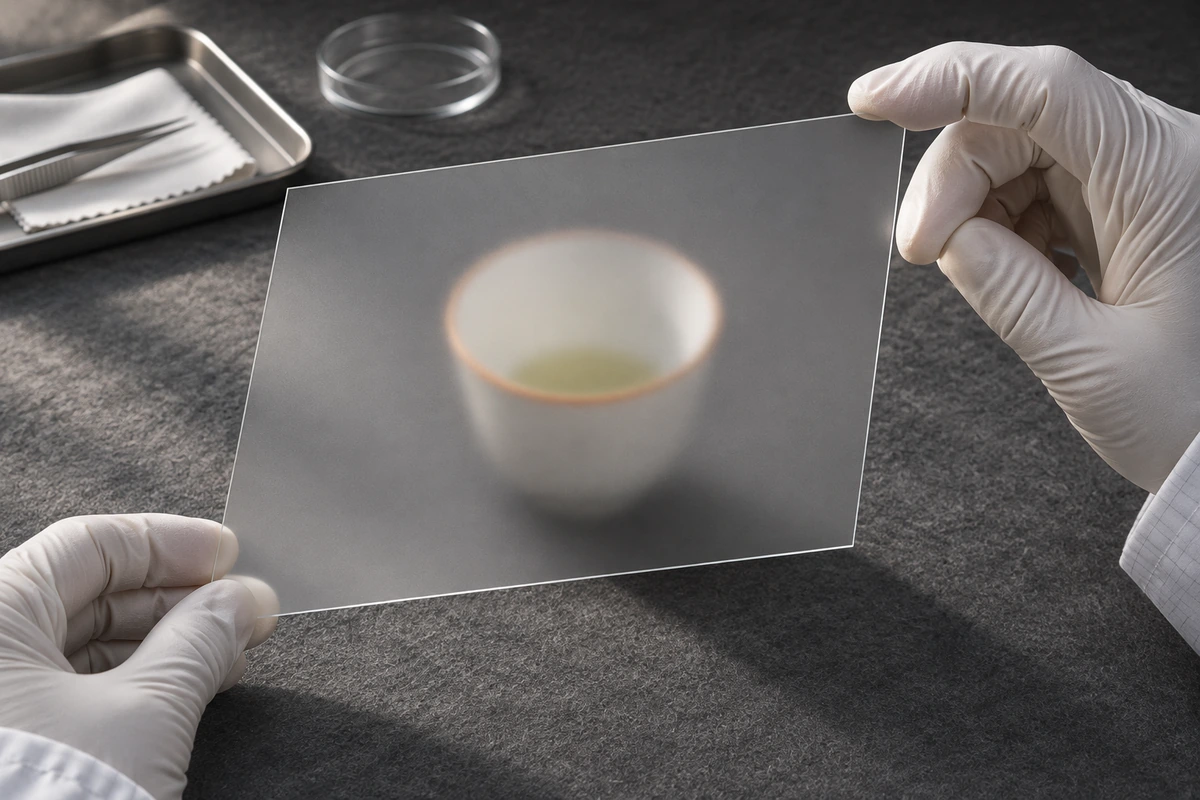
The catch is that these numbers move together. You can't make AG glass hide more glare without also softening the image, so choosing AG glass is really choosing a balance point. Here's what each number means, how they relate, and how the three types of AG glass differ.
Gloss: How Matte the Surface Is
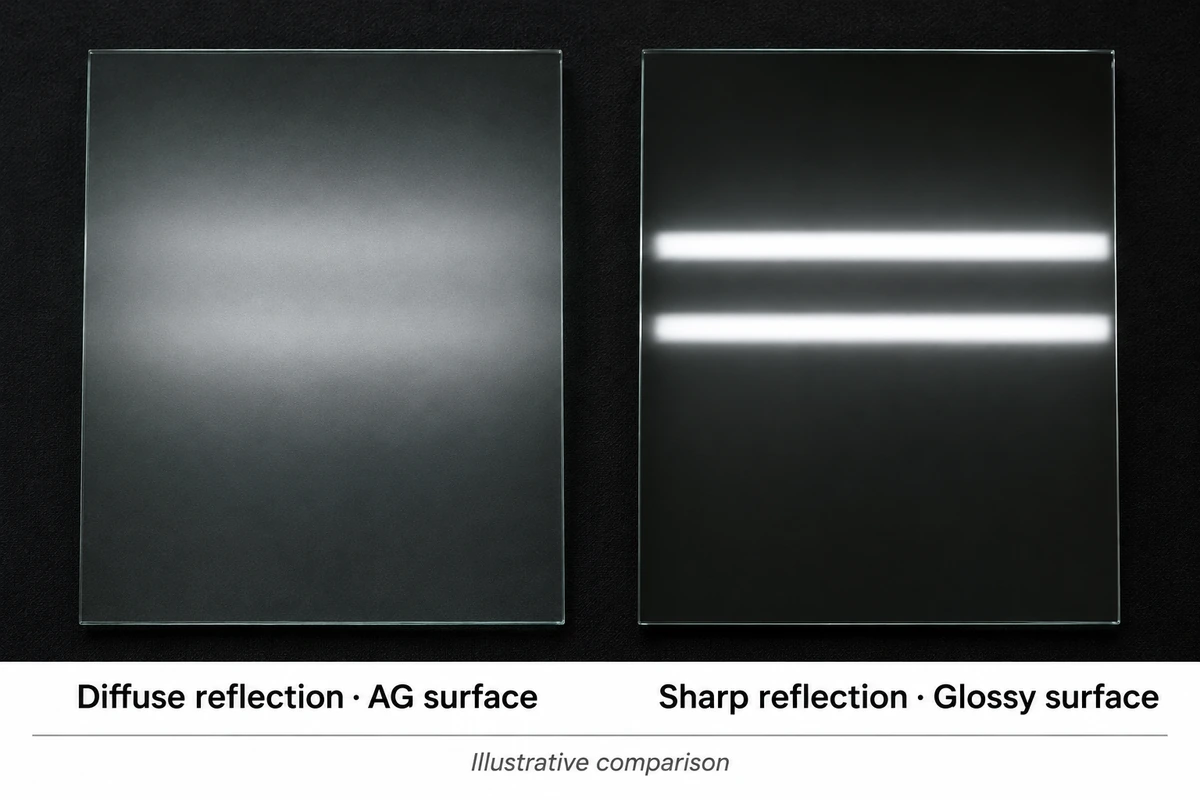
Gloss is the headline number. A gloss meter shines light onto the surface at a 60° angle and measures how much bounces back in a mirror-like way. The result is given in gloss units, usually under the ASTM D523 method.
Smooth, untreated glass scores well above 100 GU. Etched AG glass is commonly sold in standard levels such as 40, 60, 90 and 120 GU. The lower the number, the more the surface scatters light, and the softer reflections become.
Here's how one AG glass supplier matches gloss levels to use:
| Gloss level | Typical use |
|---|---|
| About 110 GU | Car displays, usually combined with AR and anti-fingerprint coatings |
| About 95 GU | Indoor screens under bright light, such as medical equipment and POS terminals |
| Below 70 GU | Outdoor screens |
| Below 50 GU | Screens in strong sunlight |
| 35 GU or less | Touch panels with no display behind them, such as trackpads |
The pattern is simple. The brighter and harsher the light, the lower the gloss you need. The sharper the image behind the glass needs to be, the higher the gloss you can afford.
Haze: How Much the Image Is Softened
Gloss describes light reflected off the surface. Haze describes light passing through it.
Haze is the share of transmitted light that gets scattered more than 2.5° away from a straight line, measured under ASTM D1003. A haze of 10% means 10% of the light coming from the screen is spread out slightly on its way to your eye. The higher the haze, the more milky or soft the image looks.
Gloss and haze move in opposite directions. In one glass maker's patent, test samples ranged from about 93 GU with 12% haze to about 23 GU with 40% haze. Etching the surface longer drops the gloss and raises the haze at the same time.
Transmittance: How Much Light Gets Through
Transmittance is the share of visible light that passes through the glass. For AG glass it's typically in the high 80s to low 90s percent. One supplier tests to a minimum of 88% across 380–700 nm.
Lower-gloss glass generally transmits slightly less light, because more of it is scattered. Transmittance rarely decides the choice, but it's worth checking on battery-powered devices, where every bit of brightness costs power.
Roughness: The Texture Behind the Numbers
Gloss and haze are results. Roughness describes the surface that causes them.
The most common roughness figure is Ra, the average height of the surface's peaks and valleys, usually a fraction of a micron on AG glass. Deeper texture generally means lower gloss and higher haze. In the same patent, a sample with Ra around 0.18 µm measured 66 GU, while a smoother one at about 0.05 µm measured 93 GU.
There's a second roughness number that matters even more for one particular problem: how far apart the bumps are. That's covered next.
Sparkle: The Problem Gloss and Haze Don't Predict
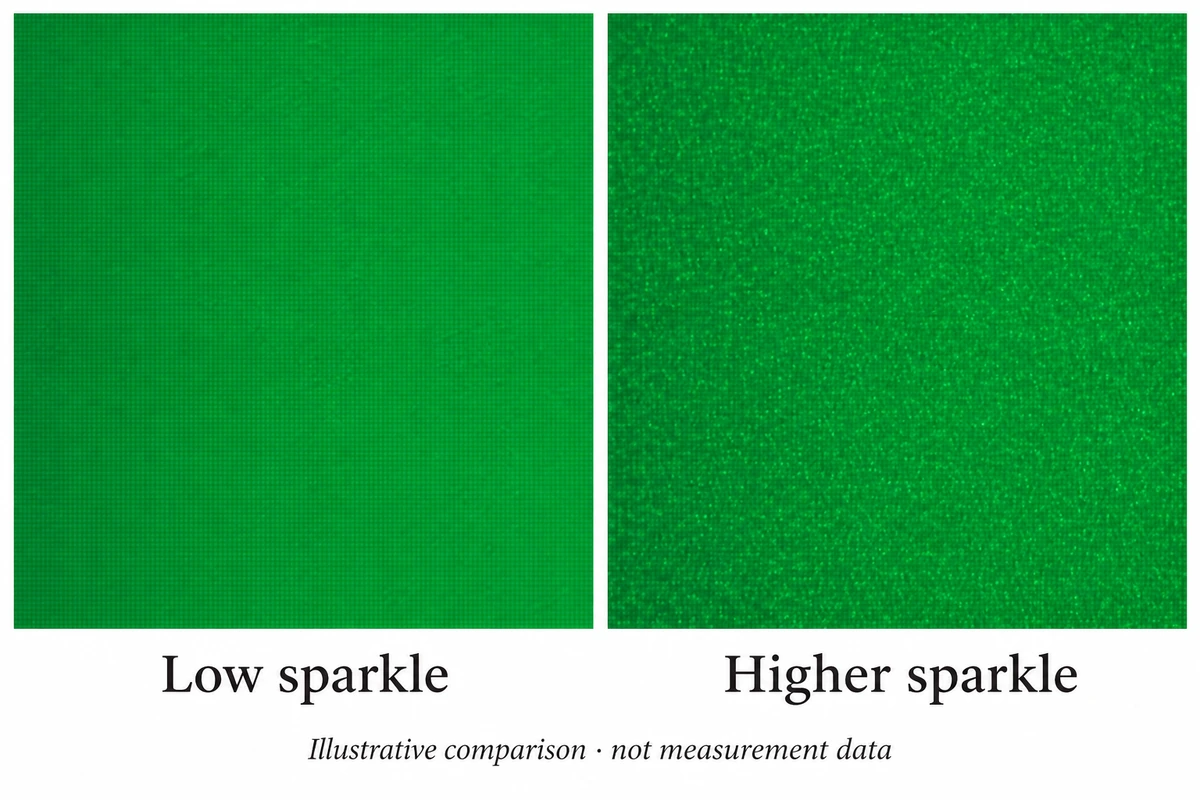
Sparkle is a grainy, glittery look that some AG glass gives a screen, especially a high-resolution one. Each bump in the AG texture acts like a tiny lens. When the bumps are about the same size as the screen's pixels, they magnify some pixels and dim others at random, and the image seems to twinkle as you move your head.
The key point is that two AG glasses with the same gloss and haze can sparkle very differently. In the patent mentioned above, sparkle depended mostly on the spacing of the texture (a roughness measure called RSm):
- Samples with texture spacing of about 12–15 µm showed almost no sparkle.
- Samples with spacing of about 40–60 µm sparkled noticeably.
- One commercial sample with very coarse texture, about 180 µm, sparkled badly.
In plain terms, a finer texture makes the bumps much smaller than the pixels, so they stop acting like magnifying lenses.
Sparkle can be measured with dedicated cameras, and there is now an international standard for it, IEC 62977-3-9. The most reliable check, though, is still to put a sample on the actual display, show a plain white or green image, and look closely.
Three Types of AG Glass
Etched AG. The glass is dipped in a controlled acid bath, usually based on hydrofluoric acid, which eats a fine texture into the surface. Because the texture is the glass itself, it doesn't wear off. It feels smooth, almost paper-like, and it holds up to constant touching and cleaning. It costs more than the alternatives, but it's the standard for touch screens, car displays and medical monitors.
Sprayed (coated) AG. A coating containing tiny particles is sprayed onto smooth glass and cured with heat or UV light. It's cheaper and makes it easy to hit a specific gloss level. The texture is a separate layer, though, so it can scratch or wear with heavy use and harsh cleaning. It suits non-touch displays, budget monitors and shorter-life products.
AG film. A plastic film with a matte surface is laminated onto the glass. It's the cheapest and easiest to replace, but it's the least durable and can look slightly plastic. It's common on screen protectors and retrofits.
If people will touch and clean the screen every day, choose etched. If the screen sits behind a frame or out of reach, sprayed AG is often good enough.

Reading an AG Glass Datasheet
Here's how a typical line of an AG glass datasheet reads, and what to take from it:
"Etched AG, 1.1 mm aluminosilicate, gloss 90 ± 10 GU, haze ≤ 10%, transmittance ≥ 90%, Ra 0.05–0.10 µm."
- Etched AG: the texture is part of the glass, so it suits a touch screen.
- Gloss 90 ± 10 GU: a fairly glossy grade that keeps the image sharp. It suits indoor screens under office lighting, not bright sunlight. Note the tolerance: parts from 80 to 100 GU all pass, so if you need consistency between batches, ask for a tighter range.
- Haze ≤ 10%: low haze, so the image stays clear.
- Transmittance ≥ 90%: almost no brightness lost.
- Ra 0.05–0.10 µm: a fine, shallow texture.
What's missing is anything about sparkle. If the screen behind it is high-resolution, ask for the texture spacing or a sparkle measurement, or simply ask for a sample to test on your screen.
If you're comparing AG glass options for a product, tell us the screen resolution and where it will be used, and we'll suggest a couple of gloss levels to try side by side.