

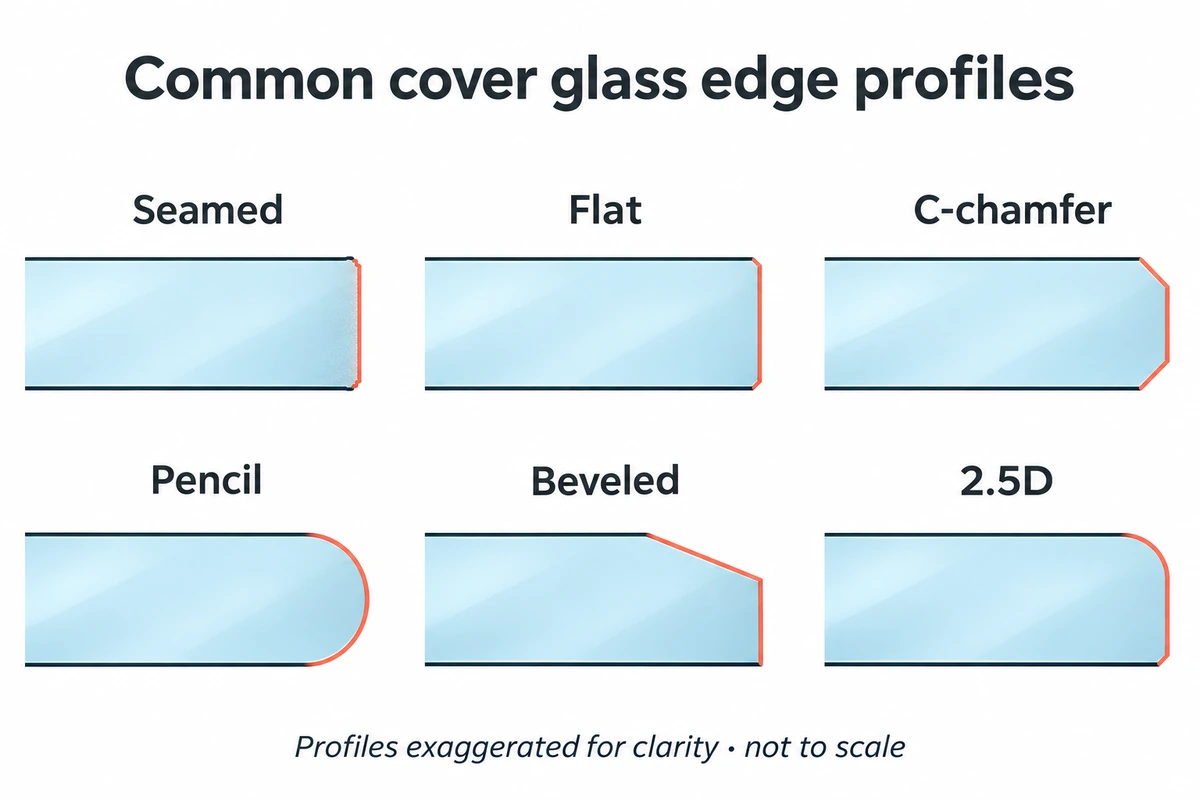
The edge is the most fragile part of a piece of glass, so it's worth getting right. Below is what each type looks like, where it works well, and a quick way to choose.
Shape and Finish Are Two Different Choices
When people talk about a glass "edge," they usually mean two separate things.
The first is the shape, or profile: flat, angled, rounded or curved. That's what the six types below describe.
The second is the finish: ground or polished. A ground edge has a frosted, satin look. A polished edge is clear and glossy, like the face of the glass. Most shapes can be made either way. Polishing adds a step, so it costs a little more, and it's mostly chosen when the edge will be visible.
Keep the two apart when talking to a supplier. "Polished edge" on its own doesn't say what shape you want, and "2.5D" doesn't say whether it should be glossy.

Seamed Edge: Safe to Handle, Not Meant to Be Seen
A seamed edge, sometimes called a safety seam or "cut and swipe," is the most basic option. After cutting, the sharp corners are lightly sanded off so the glass can be handled without cutting anyone. The surface is left rough and matte.
It's the cheapest edge, and it's fine wherever the edge disappears into a frame or housing, such as industrial monitors and machine panels. It isn't meant to look finished, so it's the wrong choice for any edge a customer will see.
Flat Edge: Straight and Clean
A flat edge is ground straight across the thickness of the glass, usually with a tiny angled cut on the top and bottom corners to remove sharpness. Left ground, it has a satin look. Polished, it has a crisp, glossy look.
Flat edges suit glass that sits in a frame but may still be partly visible, such as kiosk screens, point-of-sale terminals and appliance panels. A flat polished edge is also the usual choice for frameless glass, where the edge is on display.
C-Chamfer: The Everyday Workhorse
A chamfer is a small angled cut, usually at 45°, along the top and bottom corners of the edge. On cover glass it's often very small, a fraction of a millimeter, and it's called a "C" edge because sizes are written that way (C0.2 means a 0.2 mm chamfer).
Chamfering softens the corners and makes the edge far less likely to chip when the glass is handled or installed. That's why it's the most common edge on display and touch glass: lab screens, control panels, car displays and many more. Small holes in cover glass, such as speaker openings, often get a tiny chamfer for the same reason.
Pencil Edge: Soft and Rounded
A pencil edge, also called a round or R edge, is ground into a smooth curve, a bit like the rounded side of a pencil. It can be left satin or polished.
It feels soft to the touch, so it suits exposed edges that people handle often, such as tablets, handheld devices and interactive whiteboards. It takes more grinding than a flat or chamfered edge, so it usually costs a little more.
Beveled Edge: Mostly About Looks
A bevel is a wide, sloped face ground along the edge, anywhere from a gentle 5° to a steep 45°, and usually polished so it catches the light. Think of the edge of a framed mirror.
On displays, bevels are mostly decorative: signage, art displays and premium monitor frames. A bevel makes the edge thinner, so it suits thicker glass better than thin cover glass.
2.5D Edge: The Phone-Screen Curve
A 2.5D edge keeps the glass flat in the middle but curves the top edge down smoothly toward the sides. It's the gentle roll-off you feel when you run a thumb off the edge of most smartphone screens.
It feels smooth and looks premium, and it blends well into a device's frame. You'll see it on phones, smartwatches and tablets, and increasingly on high-end handhelds and control panels. It takes the most machining of the edges here, so it costs the most.
2.5D is different from 3D glass, where the whole sheet is bent, not just the edge.
Why the Edge Matters for Strength
Glass almost always breaks from a tiny flaw, and edges are where most of those flaws sit. Cutting and grinding leave microscopic chips and cracks, and a knock on an exposed edge adds more.
A good edge finish helps by removing those flaws and taking off sharp corners that chip easily. But a 2020 study on glass edges found something worth knowing: polishing alone doesn't guarantee a stronger edge. How well the edge is ground and polished, including the choice of tools, mattered more than whether it was polished at all. About 60% of the test pieces broke from the chamfer or the transition between chamfer and edge, not from the flat edge itself. Visible grinding marks, on the other hand, turned out to be a cosmetic issue only.
The takeaway: a well-made chamfered edge beats a poorly made "premium" one. Ask a supplier how they check edge quality, not just which finish they offer.
One more rule applies to every edge type: all edge work has to be done before the glass is strengthened. Tempered glass shatters if you try to grind it afterward. Chemically strengthened glass survives, but the newly ground edge loses its strengthened layer, which defeats the purpose.
A Simple Way to Choose
Start with how the edge will be used, and the choice usually makes itself.
If the edge is fully hidden in a frame or housing, a seamed or flat ground edge is enough. There's no reason to pay for looks no one will see.
If the edge will be visible but rarely touched, a flat polished or C-chamfered edge gives a clean look at a sensible price.
If people will touch or hold the edge, choose a pencil or 2.5D edge so it feels smooth in the hand.
If the edge is exposed to knocks, such as handhelds or devices with no protective bezel, add a chamfer at the very least, and favor rounded profiles that are less likely to chip.
If the edge is a design feature, use a polished bevel on thicker glass, or a 2.5D edge on thin cover glass.
When in doubt, a small polished chamfer is a safe default for most cover glass.
If you're not sure which edge suits your product, send us a photo or a sketch of how the glass sits in its housing, and we'll suggest a couple of options.